Top 5 Replit Alternatives (2026)
On this page
Replit has become a default choice for AI-assisted app building — a browser IDE, an autonomous Agent, a built-in Postgres database, and one-click hosting all bundled together. You describe an app, the Agent builds it, and you ship from the same tab you started in.
But Replit isn't the only path from prompt to running app. Some tools abstract the code away entirely. Others specialize in design polish, business apps, or eliminating the developer's infrastructure cost altogether. Here are five alternatives worth considering, what they do differently, and where each one is the better pick.
1. Puter.js
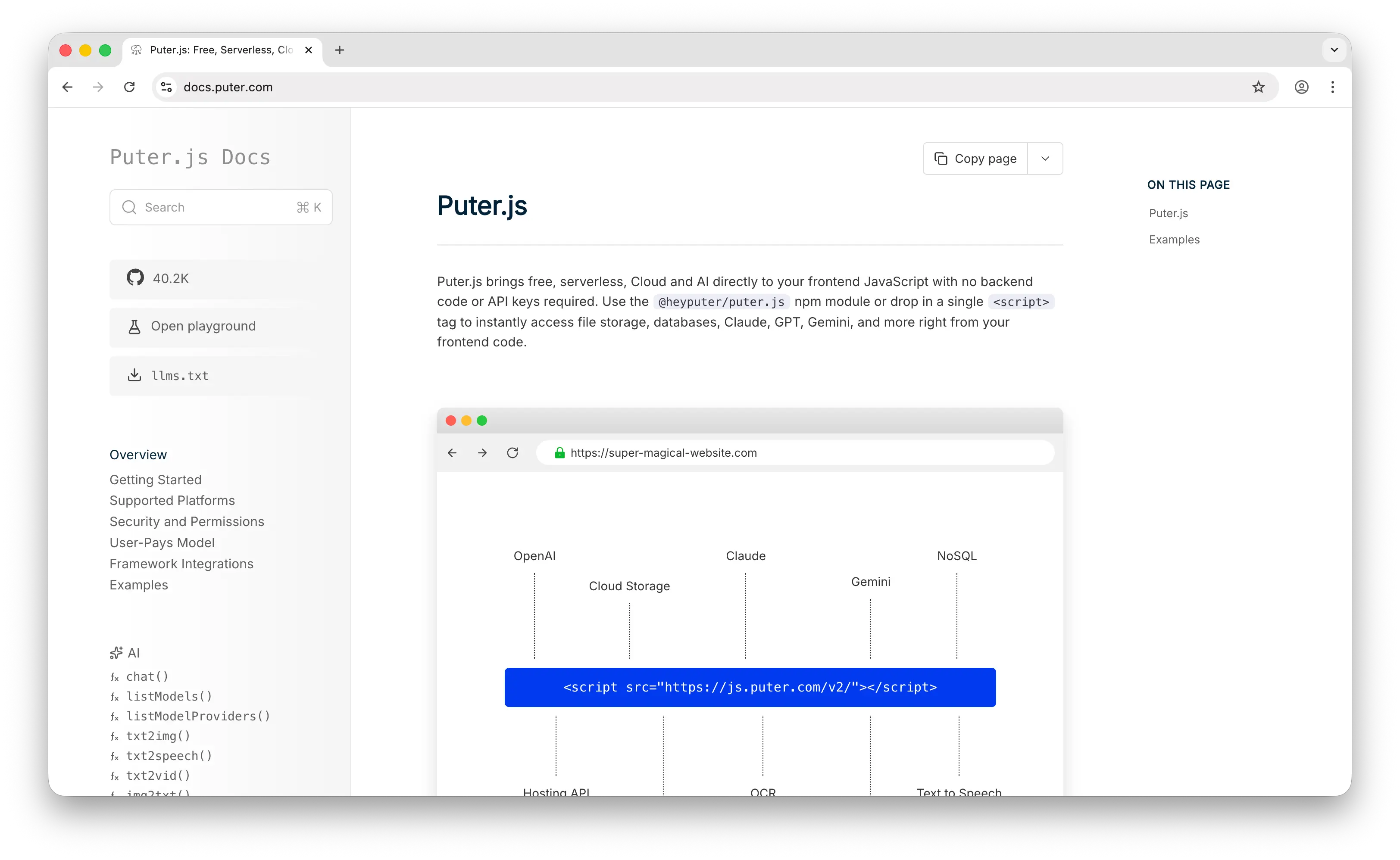
Puter.js is a client-side JavaScript library that gives you auth, a database, cloud storage, and AI without provisioning any backend. The shape is the opposite of Replit's: Replit bundles its own AI agent with its own backend and charges you for both. Puter.js lets you pair any AI coding tool — Claude Code, Cursor, Windsurf, Lovable, v0, or even Replit itself — with the Puter backend, and your users cover the runtime costs.
What Makes It Different
You bring the coding agent. Replit's Agent is the only AI builder you can use inside Replit, and it's locked to Replit's chosen model set. If you prefer Claude Code, Cursor, Windsurf, or any other tool, you're working outside the box. Puter.js doesn't care how the app gets written — a <script> tag is the entire integration. Hand-written HTML, a Cursor project, a Claude Code session, a Lovable export — anything that produces JavaScript can call Puter for auth, storage, database, and AI.
Your dev cost is $0. Replit charges the developer through Core ($20–25/month) plus effort-based Agent usage, and heavy users routinely describe the meter as "credit burn" — the Agent often bills twice on the same task when it confidently declares work done that isn't. Puter.js flips this with the User-Pays Model: your app's users sign in with their Puter account and cover their own quota for storage, database, and AI inference. Your developer infrastructure cost stays at $0 regardless of scale.
Key Differences from Replit
The shape of the two products is different. Replit is a bundled environment — IDE, terminal, version control, Agent, hosting — and you build inside it. Puter.js is a backend SDK you use from anywhere. Replit also gives you a full Postgres database; Puter gives you a NoSQL key-value store. If your app needs relational queries, foreign keys, and SQL, Replit's Postgres is the stronger fit. Puter trades that for zero-config and zero developer cost.
Comparison Table
| Feature | Puter.js | Replit |
|---|---|---|
| Product shape | Drop-in backend SDK | Bundled IDE + Agent + hosting |
| Developer cost | $0 (user-pays) | $20–25/mo + usage |
| Database type | NoSQL key-value store | Full PostgreSQL |
| SQL support |  |
 |
| Authentication | |
|
| Cloud storage | |
|
| BYO AI coding tool | Claude Code, Cursor, Lovable, etc. |
Replit Agent only |
| Hosting | |
|
| Pricing predictability | High (flat $0) | Low (effort-based credits) |
| Open-source | AGPL-3.0 |
|
| Self-hostable | |
|
| Best for | Zero-cost apps with built-in AI, BYO builder | All-in-one workspace with Postgres and an autonomous Agent |
2. Lovable
Lovable is a chat-to-app builder that generates React + Tailwind + shadcn/ui projects from natural language. It closed a $330M Series B at a $6.6B valuation in late 2025 — the biggest war chest in the category — and added mobile app generation in January 2026.
What Makes It Different
Lovable is widely considered to produce the best-looking default UI of any vibecoder. The output is React + Tailwind + shadcn/ui out of the box, and visual edits consume zero credits, which makes iterating on design cheap relative to Replit's effort-based Agent. Lovable Cloud (managed Supabase under the hood) handles DB, auth, and storage — similar coverage to Replit's native Postgres but on Supabase infrastructure.
Pricing is more predictable than Replit's: Pro is a flat $25/month with credit-based limits, where the same task tends to cost the same amount. Replit Core ($20–25/month) bills by effort, so the same prompt can charge wildly different amounts depending on how the Agent decides to approach it.
Key Differences from Replit
Lovable is chat-to-app only — no IDE, no terminal, no manual coding. Replit gives you a glass box: a full browser IDE where you can inspect, edit, and override every line the AI writes. If you want to drop into raw code, Replit lets you; Lovable prioritizes abstracting code away. Heavy users also report $100–300/month in overages on top of the Pro plan when projects get large.
Comparison Table
| Feature | Lovable | Replit |
|---|---|---|
| Product shape | Chat-to-app, no IDE | Full IDE + Agent + hosting |
| UI quality | Best-in-class (React + Tailwind + shadcn) | Functional, not designer-grade |
| Manual code editing | |
Full IDE + terminal |
| Visual edits | Zero credits |
Counts toward Agent usage |
| Mobile app generation | (Jan 2026) |
Via web wrappers |
| Database | Supabase (managed) | Native Postgres |
| Authentication | |
|
| Hosting | |
|
| Pricing model | Credit-based ($25/mo Pro) | Effort-based ($20–25/mo Core) |
| Pricing predictability | Medium (credits run out fast) | Low (effort-based) |
| Overage risk | $100–300/mo reported on heavy use | Yes |
| Open-source | |
|
| Best for | Beautiful UIs from a prompt, zero technical knowledge | Devs who want to inspect and override generated code |
3. Bolt.new
Bolt.new is StackBlitz's AI app builder that runs entirely in the browser via WebContainers — a full Node.js runtime in the browser, no remote VMs. It hit $1M ARR in its first week, added another $1M ARR each of the next two weeks, and crossed 5M registered users by May 2025 — the fastest-growing in the category.
What Makes It Different
The technical moat is WebContainers. Where Replit spins up remote VMs for every workspace, Bolt runs the entire dev environment client-side. That makes iteration fast and gives Bolt unique cost characteristics — there's no per-user VM to keep warm. It's powered by Claude and integrates with Supabase, Stripe, Figma, GitHub, and Expo for mobile.
Bolt Cloud handles hosting, DB, and auth — similar coverage to Replit but typically deploying to Netlify or Vercel rather than hosting in-platform. The flow is faster than Replit's: "describe app → see app" with the IDE essentially invisible, where Replit feels like a dev environment with AI bolted on.
Key Differences from Replit
Replit Agent does long autonomous builds (up to 200 minutes per task); Bolt is more iterative, prompt-by-prompt. Bolt's Pro plan (~$20–25/month) is token-based and reviewers consistently note that it "rarely covers a full month of active development" — similar unpredictability to Replit's effort-based billing. Generated code is also often described as "half-done" for production: great for prototypes, weaker for shipping.
Comparison Table
| Feature | Bolt.new | Replit |
|---|---|---|
| Runtime | WebContainers (browser-only) | Remote VMs |
| Product shape | Prompt-first, IDE invisible | Full IDE + Agent |
| Long autonomous builds | Iterative, prompt-by-prompt | Up to 200-min Agent runs |
| AI model | Claude | Replit Agent (fixed set) |
| Hosting | Netlify / Vercel (external) | In-platform |
| Database | Supabase | Native Postgres |
| Integrations | Supabase, Stripe, Figma, GitHub, Expo | GitHub, integrations marketplace |
| Pricing model | Token-based (~$20–25/mo Pro) | Effort-based ($20–25/mo Core) |
| Pricing predictability | Low ("rarely covers a full month") | Low (effort-based) |
| Production-readiness | Reviewers note "half-done" output | Better, but still needs cleanup |
| Open-source | |
|
| Best for | Fastest path from idea to working in-browser demo | Longer Agent runs and a full IDE you can drop into |
4. v0 by Vercel
v0 is Vercel's AI app builder, rebranded from v0.dev to v0.app in January 2026. With 6 million developers on the platform and Vercel valued at $9.3 billion, v0 has grown from a UI component generator into a full-stack platform — a February 2026 update added Git integration, a VS Code-style editor, Next.js sandboxes, and database integrations with Supabase, Snowflake, and AWS.
What Makes It Different
v0 leads the category in UI component generation quality (9.5/10) and React/Next.js code quality (9.2/10) — the strongest frontend AI generation tool available. Replit's defaults are functional but not polished. Deployment is the tightest in the category: one click to Vercel with SSL, CDN, and serverless functions wired up automatically. Code is fully exportable to GitHub, so there's no lock-in — a contrast to platforms where the generated app lives only on the host's infrastructure.
Key Differences from Replit
Replit is a generalist that supports 50+ languages. v0 is a specialist: React, Next.js, Tailwind, and shadcn/ui essentially only. If your app lives outside that stack, v0 isn't a fit. Premium is $20/month with token-based billing — similar unpredictability to Replit's effort-based pricing. The best fit is developers already in the Vercel/Next.js ecosystem; for everyone else, Replit's flexibility wins.
Comparison Table
| Feature | v0 by Vercel | Replit |
|---|---|---|
| Stack support | React + Next.js + Tailwind + shadcn only | 50+ languages |
| UI quality | 9.5/10 component gen, 9.2/10 React | Workmanlike, not designer-grade |
| IDE | VS Code-style editor (Feb 2026) | Full browser IDE + terminal |
| Git integration | |
|
| Database integrations | Supabase, Snowflake, AWS | Native Postgres |
| Deployment | One-click Vercel (SSL + CDN + functions) | In-platform |
| Code export | Full GitHub export |
|
| Vendor lock-in | Low (export anywhere) | Medium (in-platform hosting) |
| Pricing model | Token-based ($20/mo Premium) | Effort-based ($20–25/mo Core) |
| Pricing predictability | Low (complex token costs) | Low (effort-based) |
| Open-source | |
|
| Best for | Teams on Vercel/Next.js wanting designer-grade UI | Generalists building in any of 50+ languages |
5. Base44
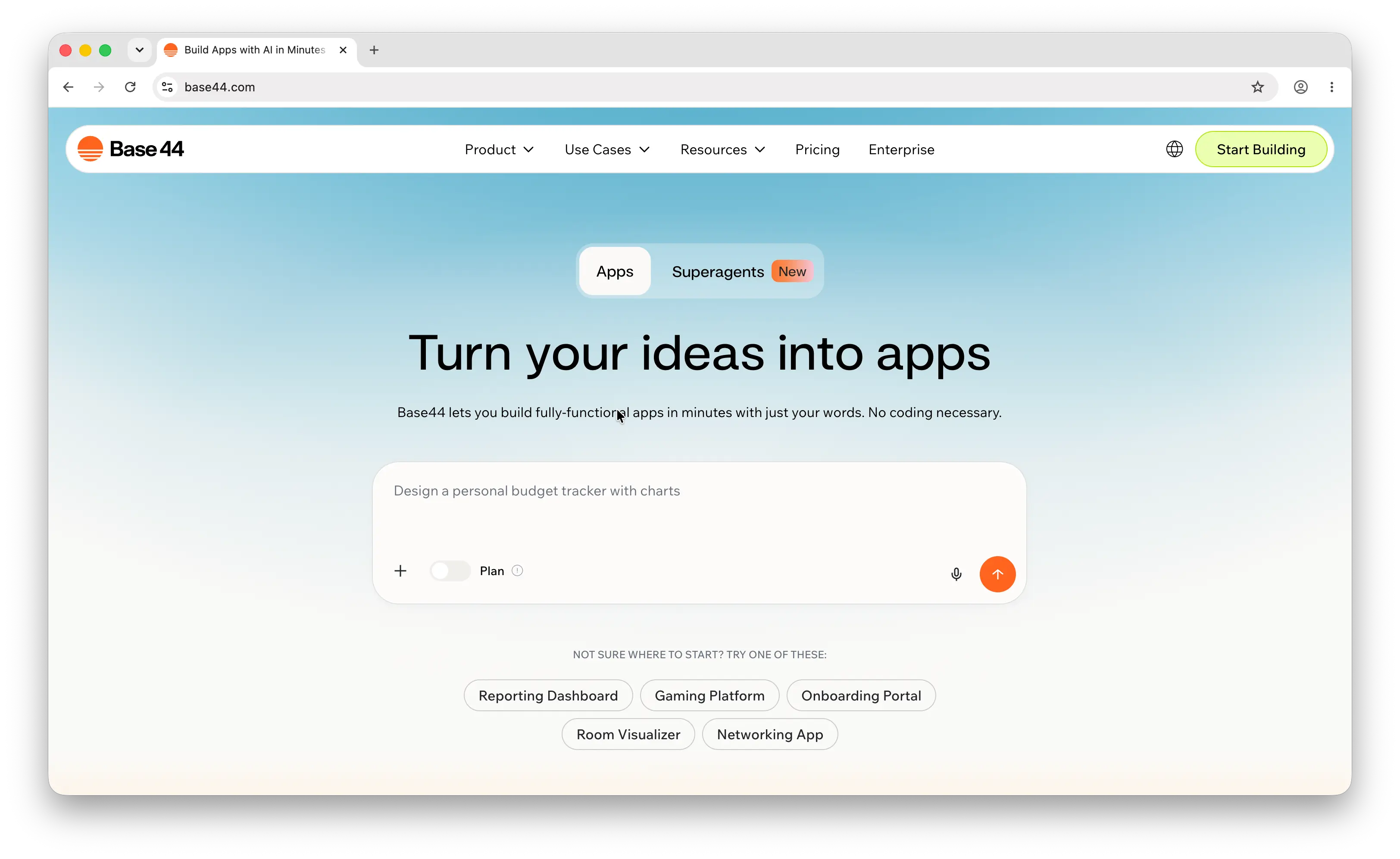
Base44 is an AI app builder focused on business and internal apps — CRMs, admin dashboards, customer portals — rather than the generalist or prototype-first positioning of Replit, Lovable, and Bolt. It was acquired by Wix for $80 million in cash in June 2025, just six months after launch, with a user base over 2 million and on track for $50M ARR by end of 2025.
What Makes It Different
Where Lovable and Bolt lean toward demos and prototypes, Base44 produces apps with real auth, real databases, real role-based permissions, and real hosting.
Built-in integrations include Salesforce, Slack, Google Workspace, LinkedIn, and GitHub (Builder+). In late 2025 and early 2026 agent benchmarks, Base44 has been one of the top performers, regularly trading first place with Cursor, Replit Agent, and Claude Code on app-build tasks.
Key Differences from Replit
Lock-in is heavier than Replit's. Apps run on Base44's infrastructure with no full source-code export; GitHub sync gives code visibility on higher plans, but true portability remains unclear. Pricing is comparable to Replit Core — Starter $16/month (annual) or $20 monthly, Builder $40/$50, Pro $80/$100 — but with credit-based limits. A platform-wide outage on February 3, 2026 took all published apps offline for 3 hours, worth noting as a reliability data point alongside the lock-in concern.
Comparison Table
| Feature | Base44 | Replit |
|---|---|---|
| Positioning | Business/internal apps (CRMs, dashboards) | Generalist |
| Output quality | Production-ready (auth + roles + DB schema) | Gets you to "it works" |
| AI model choice | Claude, Gemini, GPT-5 (plan-tiered) | Fixed model set |
| Authentication | Role-based |
|
| Database | Built-in, schema-aware | Native Postgres |
| Integrations | Salesforce, Slack, Google Workspace, LinkedIn, GitHub | GitHub, integrations marketplace |
| Hosting | In-platform | In-platform |
| Source code export | Full export not available |
Full file access in IDE |
| Vendor lock-in | High (no full export) | Medium |
| Pricing | $16/$40/$80 annual ($20/$50/$100 monthly) | $20–25/mo Core + usage |
| Pricing predictability | Medium (credit-based) | Low (effort-based) |
| Reliability note | 3-hour platform outage Feb 3, 2026 | — |
| Open-source | |
|
| Best for | Production business apps with real auth and roles | Glass-box IDE with longer Agent runs |
Which Should You Choose?
Choose Puter.js if you want zero infrastructure cost and the freedom to use any AI builder. Drop in a script tag and get auth, storage, database, and 400+ AI models with no backend to provision and no credits to burn. Your users cover their own usage. Ideal if you don't need SQL and want to escape effort-based or token-based billing entirely.
Choose Lovable if design quality matters more than flexibility. You'll get the prettiest default UI in the category — React + Tailwind + shadcn out of the box — but you trade away the ability to drop into raw code the way Replit lets you.
Choose Bolt.new if you want the fastest path from idea to in-browser demo. WebContainers make iteration snappy and the prompt-first flow is the smoothest in the category. Expect to clean up "half-done" output before shipping anything to production.
Choose v0 by Vercel if your app lives on Vercel and Next.js. You'll get designer-grade UI, one-click deployment, and full GitHub export. Outside the React/Next.js stack, v0 isn't a fit.
Choose Base44 if you're building business or internal apps that need real auth, roles, and a real database schema out of the box. Accept the heavier lock-in and the credit-based pricing.
Stick with Replit if you want the full glass-box experience — a real IDE, a terminal, version control, an Agent that can run for up to 200 minutes autonomously, and 50+ languages of generalist support. For developers who want to inspect and override every line the AI writes, Replit remains the strongest overall choice.
Conclusion
The top 5 Replit alternatives are Puter.js, Lovable, Bolt.new, v0 by Vercel, and Base44. Each takes a different approach to AI-assisted app building: Puter.js eliminates developer infrastructure cost entirely, Lovable produces designer-grade UIs from chat, Bolt.new runs everything in the browser via WebContainers, v0 owns the React/Next.js stack on Vercel, and Base44 ships production business apps with real auth and roles. The best choice depends on whether you want a bundled environment, a chat-only builder, or a backend you can drop into anything.
Related
- Getting Started with Puter.js
- The Best Backend Platform for Vibe Coding
- Top 5 Bolt.new Alternatives (2026)
- User-Pays Model vs. Traditional Model
- How to Host a Website for Free
- Top 5 Glitch Alternatives (2026)
- Top 5 Heroku Alternatives (2026)
- Top 5 Render Alternatives (2026)
- Top 5 Railway Alternatives (2026)
- Top 5 Fly.io Alternatives (2026)
- Best Vercel Alternatives (2026)
- Top 5 Netlify Alternatives (2026)
- Top 5 Firebase Alternatives (2026)
- Top 5 Supabase Alternatives (2026)
- Best Appwrite Alternatives (2026)
- Top 5 PocketBase Alternatives (2026)
- Best Neocities Alternatives (2026)
Free, Serverless AI and Cloud
Start creating powerful web applications with Puter.js in seconds!
Get Started Now