Top 5 Turso Alternatives (2026)
On this page
Turso has carved out a distinctive niche as the "SQLite for production" database. Built on libSQL (their open-source SQLite fork) and a newer Rust rewrite called Turso Database, it offers edge-replicated SQLite, embedded replicas that sync to a local file, native vector search, and a multi-database architecture where every user, tenant, or AI agent can have their own isolated database.
But Turso isn't the right fit for every workload. Some teams need full PostgreSQL or MySQL. Others need a document model, AWS-native integration, or a fundamentally different cost structure. It's also worth noting that Turso deprecated scale-to-zero in 2025 and pivoted heavily toward AI-agent marketing — changes that have pushed some developers to look elsewhere. Here are five alternatives worth considering, what they do differently, and where each one is the better pick.
1. Puter.js
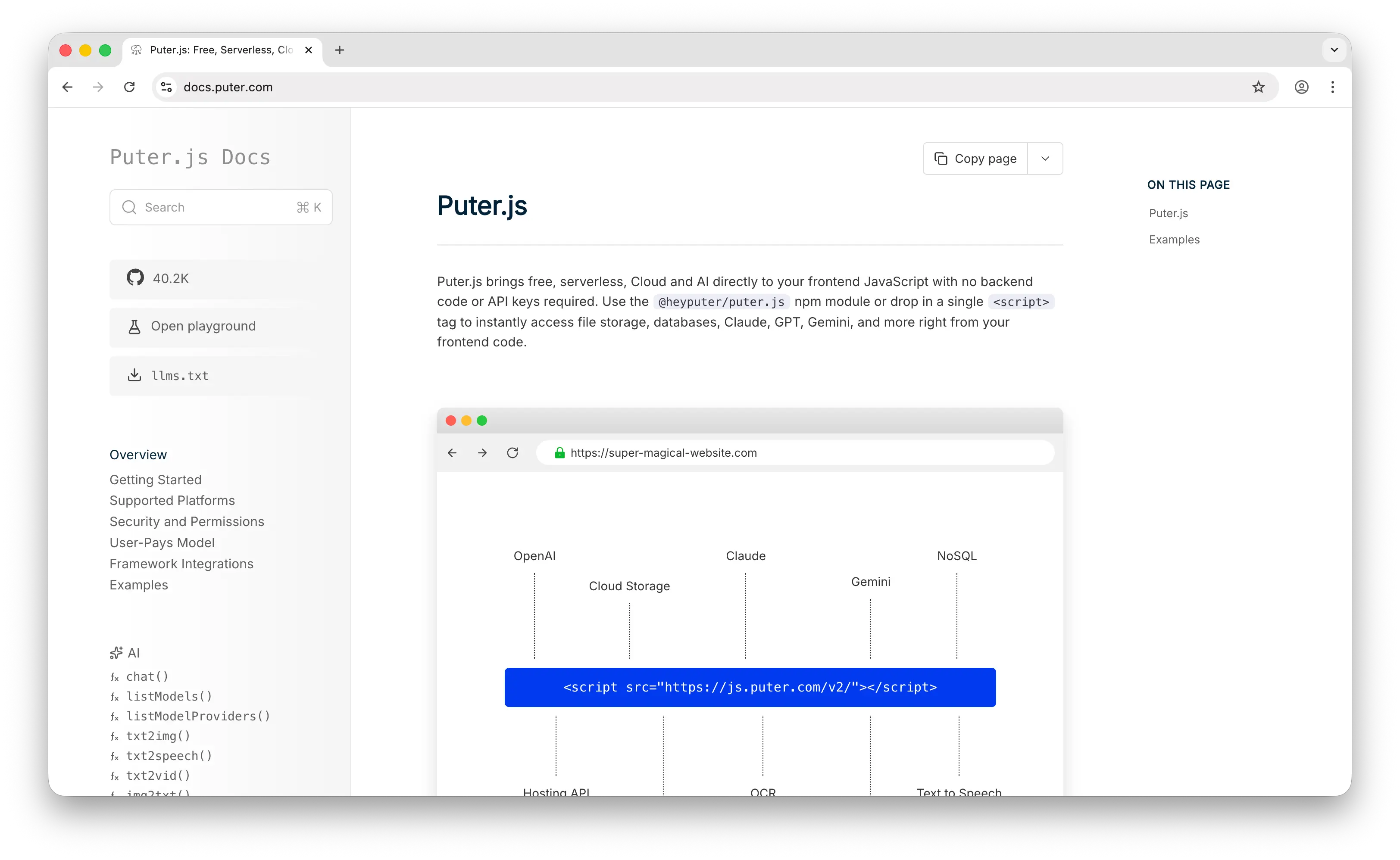
Puter.js is a client-side JavaScript library that gives you a cloud database, object storage, auth, and AI without provisioning anything. Where Turso requires you to create a project, manage auth tokens, install the libSQL client, and wire up a server-side connection, Puter.js is a single <script> tag.
What Makes It Different
With Turso, the developer pays — for storage, for monthly active databases, for row reads. Costs scale with your app's success. Puter.js flips this with the User-Pays Model: your app's users cover their own usage through their Puter account. Your cost as a developer stays at zero regardless of scale. This isn't a free tier you'll outgrow — it's a fundamentally different cost structure.
Puter.js also handles multi-tenancy for free. Turso's pitch is "give every user their own database" — but you still have to provision them, manage tokens, and pay per active database. With Puter.js, each signed-in user automatically gets their own isolated namespace. No multi-tenant architecture to design.
Beyond the database, Puter.js ships with 500+ AI models — chat, image generation, OCR, text-to-speech — alongside cloud storage, auth, and hosting in the same library. Turso is database-only; everything else is BYO.
Puter is open-source (AGPL-3.0) and self-hostable.
Key Differences from Turso
The data model is where they diverge most. Puter.js provides a NoSQL key-value store with set, get, del, list, atomic increment/decrement, TTLs, and prefix-based queries. Turso gives you full SQLite — joins, transactions, indexes, vector search, and the entire SQL surface. If your app needs relational modeling, complex queries, or vector similarity search at the database level, Turso is the stronger choice. Puter.js trades that power for zero-config simplicity and zero developer cost.
Comparison Table
| Feature | Puter.js | Turso |
|---|---|---|
| Setup required | Drop-in script tag | CLI + auth token + libSQL client |
| Pricing model | User-pays (free for devs) | Tier-based + per-DB/row-read |
| Database type | NoSQL key-value store | SQLite (libSQL) — full SQL |
| SQL support |  |
 Full SQLite Full SQLite |
| Vector search | |
Native |
| Edge replication | |
300+ locations |
| Embedded local replicas | |
|
| Multi-tenant isolation | Automatic per-user |
Manual (DB-per-tenant) |
| Authentication | |
|
| Cloud storage | |
|
| Built-in AI | 400+ models |
|
| Open-source | AGPL-3.0 |
(libSQL, MIT) |
| Best for | Zero-cost, zero-config web apps with built-in AI | SQL apps needing edge reads and per-tenant SQLite |
2. DynamoDB
DynamoDB is AWS's fully managed serverless NoSQL database. It's been the gold standard for key-value workloads at scale since 2012, powering everything from Lyft's ride matching to Disney+ streaming metadata. If Turso is "SQLite for the next generation of agents," DynamoDB is "the database that already runs the internet."
What Makes It Different
DynamoDB delivers single-digit millisecond latency at any scale, with no cold starts, no version upgrades, and no maintenance windows. Its Global Tables feature provides multi-Region active-active replication with up to 99.999% availability and strong consistency across regions — far more mature than Turso's primary-replica edge model. For applications that need zero RPO (recovery point objective) across continents, nothing else on this list comes close.
The AWS ecosystem integration is the real moat. DynamoDB Streams pipe change events directly to Lambda for CDC workflows. DAX adds an in-memory cache layer for microsecond reads on hot data. IAM controls every access pattern. If your app is already on AWS, DynamoDB integrates in ways no third-party database can match.
In December 2025, AWS introduced Database Savings Plans, which apply commitment-based discounts to DynamoDB on-demand usage for the first time — historically a gap in DynamoDB's pricing model.
Key Differences from Turso
Pricing models are opposite. DynamoDB charges per request: $1.25 per million writes, $0.25 per million reads on-demand, plus $0.25/GB-month storage (with 25GB free). Turso bills per monthly active database and row reads. For spiky, unpredictable workloads, DynamoDB scales smoothly to zero on demand mode — for steady high traffic, provisioned capacity is often dramatically cheaper.
The hidden cost trap to know about: every Global Secondary Index doubles your write costs for that index. Teams routinely model DynamoDB at $200/month and get bills of $800+ once GSIs, Streams, and Global Tables replication compound.
DynamoDB also has no edge story like Turso's. Its Global Tables replicate across AWS regions, not across 300+ POPs. And there's no equivalent to Turso's embedded replicas — you can't sync a local DynamoDB file into your app process.
Comparison Table
| Feature | DynamoDB | Turso |
|---|---|---|
| Database type | NoSQL key-value + document | SQLite (libSQL) — full SQL |
| SQL support | (PartiQL only) |
Full SQLite |
| Vector search | |
Native |
| Edge replication | (regional Global Tables) |
300+ locations |
| Embedded local replicas | |
|
| Multi-region active-active | Up to 99.999% SLA |
Limited |
| Change data capture | Streams + Lambda |
|
| Free tier | 25GB permanent |
5GB, 500M row reads |
| Pricing model | Pay-per-request or provisioned | Tier-based + monthly active DBs |
| Cost predictability | Low (GSI/Streams compound) | Medium |
| Vendor lock-in | High (AWS-specific) | Low (libSQL is OSS) |
| Open-source | |
|
| Best for | AWS-native apps needing proven scale and ecosystem integration | Apps needing SQL, edge reads, or per-tenant isolation |
3. MongoDB
MongoDB is the dominant document database. Its managed service, MongoDB Atlas, runs across AWS, GCP, and Azure with a feature set that has aggressively expanded into AI territory over the past year. Where Turso bets on small, distributed SQLite files, MongoDB bets on one rich document store that does everything.
What Makes It Different
MongoDB's schema-flexible document model fits naturally for application data that doesn't map cleanly to rows and columns — nested objects, variable fields, polymorphic records. The Atlas Vector Search feature stores embeddings alongside operational data in the same documents, eliminating the sync problem most teams hit when using a separate vector database. Turso has native vector search too, but MongoDB's HNSW-based ANN implementation is more mature and supports up to 8,192-dimensional embeddings with hybrid filtering.
In January 2026, MongoDB integrated Voyage AI's embedding and reranking models directly into Atlas, with Automated Embedding that generates and syncs vectors natively as data changes — no external pipeline needed. As of September 2025, vector search is no longer Atlas-exclusive; it's available in MongoDB Community Edition and Enterprise Server too. That's a meaningful shift for teams that want to self-host.
Atlas Serverless scales-to-zero (unlike Turso, which deprecated that feature), and the platform supports ACID transactions across documents, change streams for CDC, and built-in full-text search alongside vector search.
Key Differences from Turso
Different mental model entirely. MongoDB documents are deeply nested JSON-like structures with no schema enforcement by default; Turso is strict SQL tables with foreign keys, joins, and ACID guarantees on a single SQLite file. If your data is naturally relational, Turso is simpler to model. If it's hierarchical and varies per record, MongoDB fits better.
MongoDB has no equivalent to Turso's embedded replicas or per-tenant database model. Atlas replicates across regions, not to 300+ edge POPs. And MongoDB clusters are heavier — a single replica set with three nodes is the minimum production deployment, where a Turso database is just a file.
Comparison Table
| Feature | MongoDB | Turso |
|---|---|---|
| Database type | Document (BSON/JSON) | SQLite (libSQL) — relational |
| SQL support | (MQL aggregation) |
Full SQLite |
| Vector search | HNSW + auto-embedding |
Native |
| Full-text search | Atlas Search |
Limited (FTS5) |
| Scale-to-zero | Atlas Serverless |
(deprecated 2025) |
| Edge replication | |
300+ locations |
| Embedded local replicas | |
|
| Multi-cloud | AWS + GCP + Azure |
AWS + GCP + Azure |
| ACID transactions | Multi-document |
Single DB |
| Built-in AI/embedding | Voyage AI integrated |
|
| Open-source | SSPL (Community) |
libSQL MIT |
| Self-hostable | |
|
| Best for | Document-shaped data with mature AI/vector needs | Relational data needing edge reads or per-tenant SQLite |
4. Neon
Neon is serverless PostgreSQL with a disaggregated architecture — compute and storage are completely separated. That separation enables two features that define the product: true scale-to-zero and copy-on-write database branching. Databricks acquired Neon in May 2025 for approximately $1 billion.
What Makes It Different
Neon's branching is the closest competitor to Turso's "many databases" model, but with a fundamentally different mechanism. Where Turso gives each tenant their own independent SQLite file, Neon creates instant copy-on-write branches of your Postgres database — every PR, every developer, every CI run can have its own isolated database in under a second, using near-zero additional storage. Branches included free on the Launch plan, then $1.50 per extra branch-month.
Neon also delivers something Turso no longer does: real scale-to-zero. Idle databases suspend after about 5 minutes with a 300-500ms wake time. For variable workloads, side projects, or staging environments, this is dramatically cheaper than always-on infrastructure.
The Databricks acquisition came with aggressive pricing cuts. Compute costs dropped 15-25%, storage fell from $1.75 to $0.35 per GB-month, and the free plan compute allowance doubled to 100 CU-hours/month. For most startups and indie developers, Neon's free tier now handles real production workloads.
Neon is open-source under Apache 2.0 and integrates natively with Vercel's edge runtime via its serverless driver.
Key Differences from Turso
Different SQL flavor entirely. Neon gives you full PostgreSQL — JSONB, window functions, CTEs, row-level security, 80+ extensions including pgvector. Turso gives you SQLite, which is excellent but more constrained for complex queries and heavy concurrent writes.
Neon has no edge replication. It's regional Postgres, not globally distributed SQLite. There's also no embedded-replica equivalent — you can't sync a Neon database into your app process the way you can with Turso. And Neon's cold-start latency, while fast, is real; Turso's always-on model has no cold starts at all anymore.
Comparison Table
| Feature | Neon | Turso |
|---|---|---|
| Database type | PostgreSQL | SQLite (libSQL) |
| SQL support | Full PostgreSQL |
SQLite dialect |
| Extensions | 80+ (including pgvector) |
Limited |
| Scale-to-zero | 300-500ms wake |
(deprecated 2025) |
| Database branching | Instant copy-on-write |
Via DB-per-tenant pattern |
| Edge replication | |
300+ locations |
| Embedded local replicas | |
|
| Vector search | Via pgvector |
Native |
| Free tier | 0.5GB, 100 CU-hours |
5GB, 500M row reads |
| Paid plan starts | $19/mo (Launch) | $4.99/mo (Developer) |
| Vercel integration | Native |
Limited |
| Open-source | Apache 2.0 |
libSQL MIT |
| Best for | Full Postgres with serverless economics and Git-like branching | Edge reads, per-tenant SQLite, or embedded local replicas |
5. PlanetScale
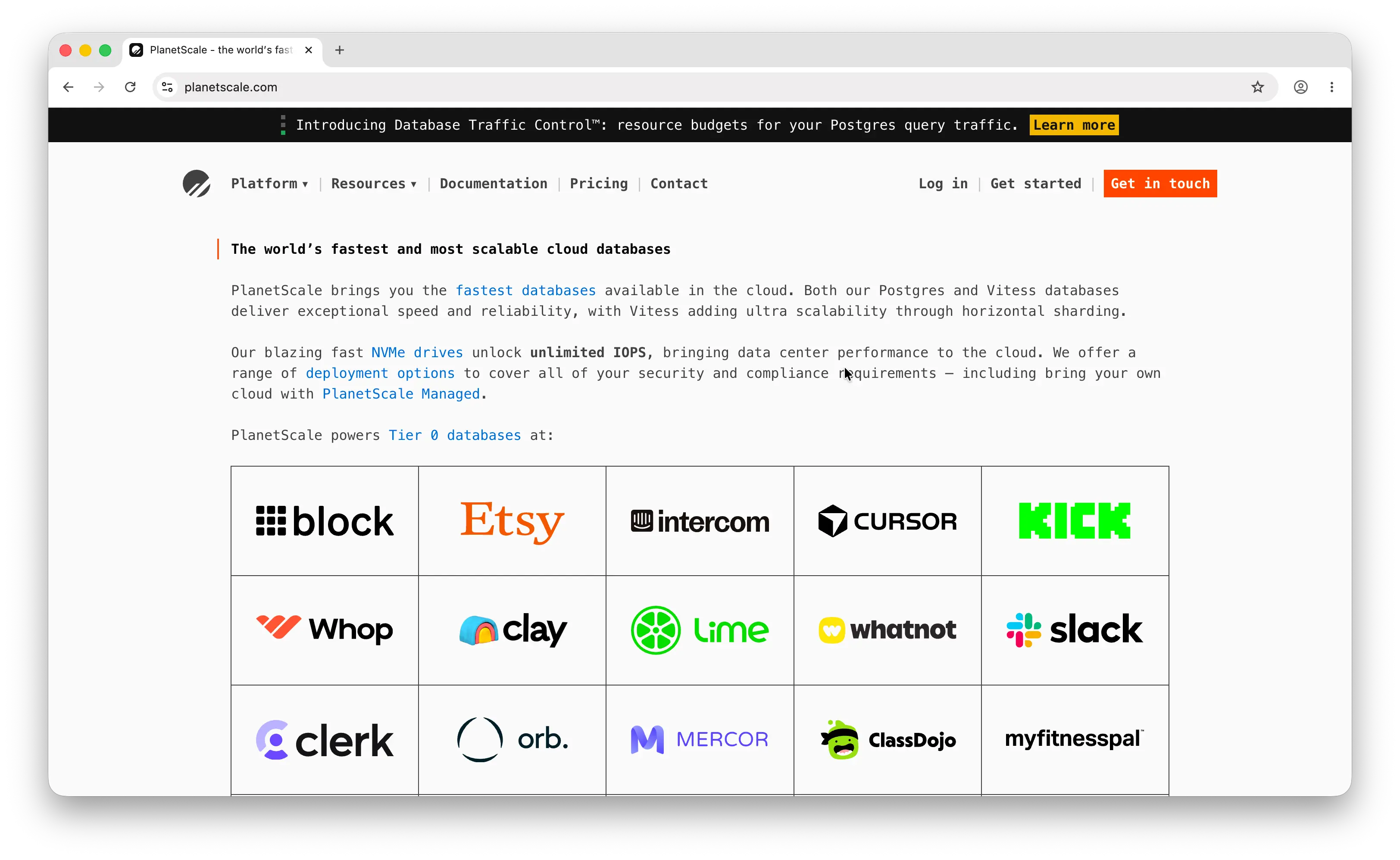
PlanetScale is a managed database platform offering both MySQL (via Vitess) and PostgreSQL (via their new Neki sharding engine, GA late 2025). Built by the team behind Vitess at YouTube, it powers some of the largest production databases on the internet — Slack, GitHub, Block, Etsy, HubSpot, and Bloomberg.
What Makes It Different
PlanetScale's defining feature is its branching and deploy request workflow — Git-like schema management for production databases. You create a branch, apply schema changes, open a deploy request with a visible diff, and merge with zero downtime. Turso's "branches" are isolated SQLite copies; PlanetScale's are about safe schema evolution at enterprise scale.
PlanetScale Metal, launched as their performance tier, uses locally-attached NVMe drives instead of network-attached storage. It delivers unlimited IOPS at ultra-low latency and is benchmarked as the fastest Postgres in the cloud. Starting at $50/month, it's positioned for teams whose database performance is a business bottleneck — a different market than Turso's "small, distributed, many" pitch.
Vitess underneath provides horizontal sharding for MySQL — the same technology that scales YouTube's database to petabytes across 70,000+ nodes. Nothing in the Turso ecosystem matches that for write-heavy, multi-region workloads.
PlanetScale also supports vector data alongside relational data on both MySQL and Postgres, with no separate vector database needed.
Key Differences from Turso
The biggest difference is the price floor. PlanetScale eliminated its free Hobby tier in April 2024. The cheapest option is now $5/month for a single-node Postgres database; MySQL clusters start at $39/month on the Base plan. Turso has a generous free tier. If you're prototyping or shipping a side project, PlanetScale is paid-only from day one.
PlanetScale is always-on with no scale-to-zero (similar to Turso's current state) and no edge replication. Branches run on dedicated clusters and are billed prorated to the millisecond — different economics from Turso's per-database/per-row-read model.
Comparison Table
| Feature | PlanetScale | Turso |
|---|---|---|
| Database type | MySQL (Vitess) + PostgreSQL | SQLite (libSQL) |
| SQL support | MySQL or Postgres |
SQLite dialect |
| Horizontal sharding | Vitess |
(DB-per-tenant pattern) |
| Schema branching | Deploy requests |
Via DB-per-tenant |
| Zero-downtime migrations | Non-blocking |
Manual |
| Edge replication | |
300+ locations |
| Embedded local replicas | |
|
| Vector search | MySQL + Postgres |
Native |
| NVMe storage tier | Metal ($50/mo+) |
|
| Free tier | (removed Apr 2024) |
5GB, 500M row reads |
| Paid plan starts | $5/mo (Postgres single-node) | $4.99/mo (Developer) |
| Cold starts | (always-on) |
(always-on) |
| Open-source | Partial (Vitess) | libSQL MIT |
| Best for | Production MySQL/Postgres at scale needing zero-downtime schema changes | Edge reads, per-tenant SQLite, or embedded local replicas |
Which Should You Choose?
Choose Puter.js if you're building a web app and want zero-cost, zero-config simplicity. Drop in a script tag and get a database, auth, storage, and AI with no backend. Ideal if you don't need full SQL and want your users to cover their own usage costs.
Choose DynamoDB if you're already on AWS or building for a future where your app needs to integrate deeply with Lambda, Streams, Kinesis, and IAM. Best for proven scale, multi-region active-active replication, and the security/compliance posture enterprise customers expect.
Choose MongoDB if your data is naturally document-shaped or you're building an AI application where mature vector search, automated embeddings, and hybrid retrieval matter more than relational modeling. The Atlas + Voyage AI integration is the most complete operational+AI data platform available today.
Choose Neon if you want serverless PostgreSQL with true scale-to-zero, Git-like database branching for every PR, and the broader Postgres ecosystem. Best fit when you need full SQL features (JSONB, RLS, extensions) and your traffic is bursty or unpredictable.
Choose PlanetScale if you have a serious production workload with budget and need MySQL or Postgres at scale, with non-blocking schema changes and NVMe-grade performance. Best for teams whose database is a critical path and who need the deploy-request workflow for safe schema evolution.
Stick with Turso if your app benefits from edge-replicated reads across 300+ locations, you want SQLite's simplicity at the file-per-tenant level, or you need embedded local replicas for microsecond reads inside your app process. For multi-tenant SaaS, mobile-first apps with offline sync, or AI agent architectures, Turso remains a strong choice.
Conclusion
The top 5 Turso alternatives are Puter.js, DynamoDB, MongoDB, Neon, and PlanetScale. Each takes a different approach to data storage: Puter.js eliminates the database entirely by putting it client-side with user-paid usage, DynamoDB delivers AWS-native scale, MongoDB owns the document + vector AI space, Neon brings serverless economics and branching to full PostgreSQL, and PlanetScale offers enterprise MySQL and Postgres with the safest schema-change workflow in the industry. The best choice depends on your data model, scale expectations, and whether you want to pay for infrastructure or push that cost to your users.
Related
- Getting Started with Puter.js
- How to Use Puter.js Key-Value Store API
- Add a Key-Value Store to Your App: A Free Alternative to DynamoDB
- Top 5 DynamoDB Alternatives (2026)
- Top 5 MongoDB Alternatives (2026)
- Top 5 Neon Alternatives (2026)
- Top 5 PlanetScale Alternatives (2026)
- Top 5 PostgreSQL Alternatives (2026)
- Top 5 Supabase Alternatives (2026)
- Top 5 Firebase Alternatives (2026)
- Best Convex Alternatives (2026)
- Best Appwrite Alternatives (2026)
- Top 5 PocketBase Alternatives (2026)
- Top 5 Upstash Alternatives (2026)
- Top 5 Redis Alternatives (2026)
- Top 5 Memcached Alternatives (2026)
Ship a Full-Stack App with One Prompt
Create a to-do list app using Puter.js
Coding manually? see the guide