Best Convex Alternatives (2026)
On this page
Convex is a reactive backend-as-a-service built around a proprietary document database and TypeScript-first server functions. You write queries, mutations, and actions as pure TypeScript files, and connected clients update automatically whenever the underlying data changes — no WebSocket setup, no cache invalidation, no manual subscription wiring. Every mutation is fully ACID, the schema is generated from your TypeScript, and the open-source backend can be self-hosted.
But Convex's opinionated model isn't a fit for every project. Some teams need standard SQL and relational modeling. Others want zero infrastructure cost regardless of scale, mature mobile SDKs with offline sync, full data sovereignty, or an escape hatch into a broader cloud ecosystem. Here are five alternatives worth considering, what they do differently, and where each one is the better pick.
1. Puter.js
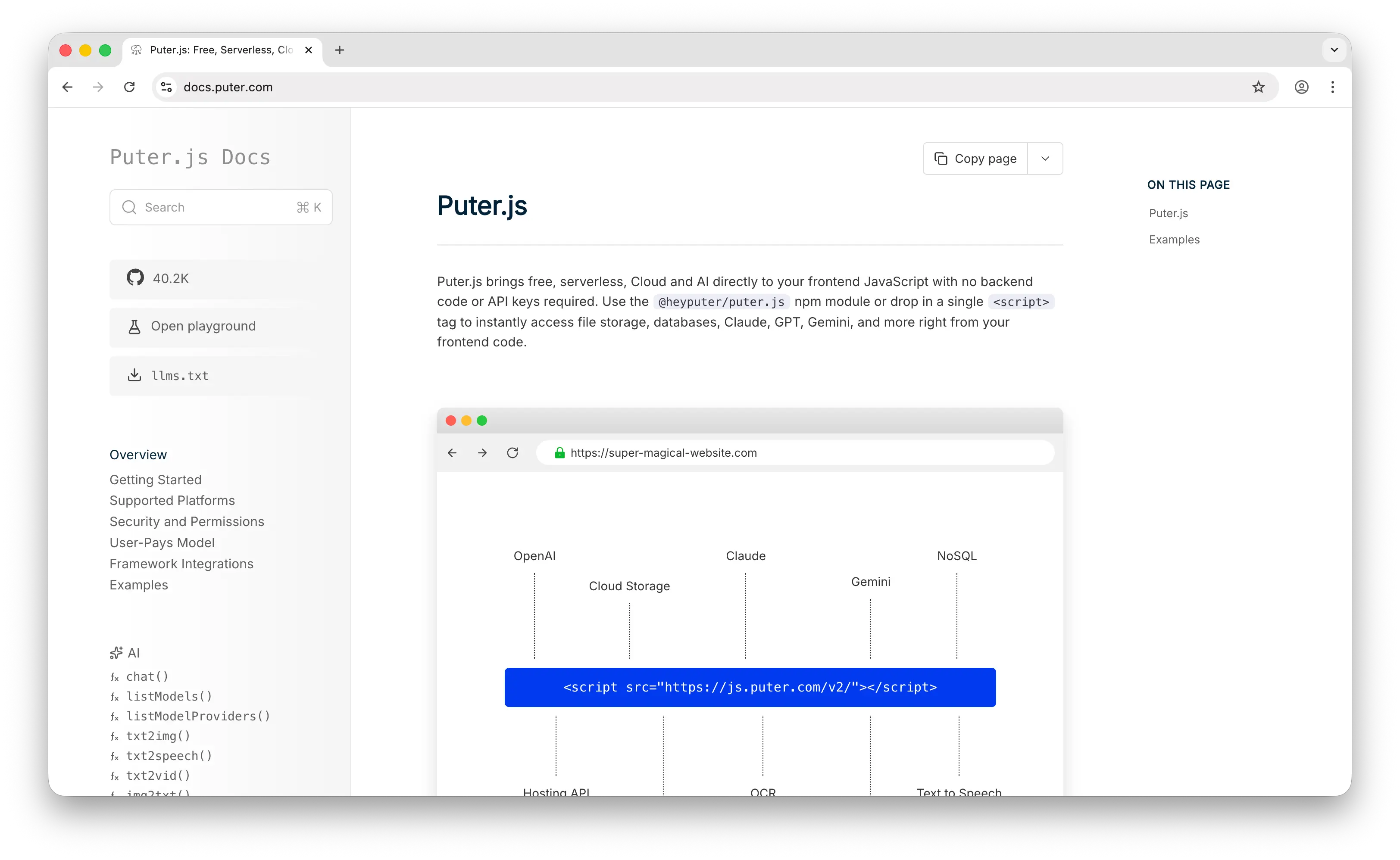
Puter.js is a client-side JavaScript library that gives you auth, a database, cloud storage, and access to 500+ AI models — all from a single script tag, with no backend to deploy and no API keys to manage. Where Convex requires a project, schema, deployed functions, and a billing relationship tied to your app's usage, Puter.js is a <script> tag and a few lines of JavaScript.
What Makes It Different
The biggest divergence is who pays. Convex gives you a free tier (1M function calls, 0.5GB database storage) and charges the developer for everything beyond it — Pro starts at $25/month and scales with your app's usage. Puter.js eliminates this entirely with the User-Pays Model: every authenticated user covers their own storage, database, and AI usage through their Puter account. Your cost as a developer stays at zero whether you have 1 user or 1 million. This isn't a generous free tier you'll eventually outgrow — it's a fundamentally different cost structure.
AI is the other big differentiator. Puter.js ships with built-in access to 500+ AI models — GPT, Claude, Gemini, Grok, DeepSeek, DALL·E, and more — all callable directly from the frontend with no API keys. Convex has no native AI models; you bring your own keys for OpenAI, Anthropic, etc., and pay those providers separately on top of your Convex bill.
Puter is also fully open-source (AGPL-3.0) and self-hostable. For apps that need backend logic, it supports Serverless Workers — JavaScript functions with a router-based API that integrate directly with Puter's services.
Key Differences from Convex
The database model is where they diverge most. Convex gives you a reactive document database with typed schemas, indexes, and live queries — every subscription updates clients automatically when data changes. Puter.js gives you a NoSQL key-value store optimized for simple lookups: no indexing, no complex queries, no relational modeling. If your app needs structured querying or reactive sync as a core primitive, Convex is the stronger choice. Puter.js trades that power for zero-config, zero-cost simplicity and a frontend-only programming model.
Convex is also TypeScript end-to-end with compile-time type safety from schema to client. Puter.js is JavaScript-first and looser by design — easier to drop into any HTML file, harder to scale into a large typed codebase.
Comparison Table
| Feature | Puter.js | Convex |
|---|---|---|
| Setup required | Drop-in script tag | Project setup + deploy functions |
| Pricing model | User-pays (free for devs) | Usage-based ($0 / $25+ per month) |
| Database type | NoSQL key-value store | Reactive document database |
| Database querying | Key lookup only |  Indexes, filters, reactive queries Indexes, filters, reactive queries |
| Real-time | |
Automatic on every query |
| ACID transactions |  |
Default |
| Type safety | Partial (JS-first) | End-to-end TypeScript |
| Authentication | |
|
| Cloud storage | |
|
| Built-in AI | 400+ models, no API keys |
(bring your own keys) |
| Serverless functions | Serverless Workers | TypeScript actions |
| Scheduled jobs | |
Cron |
| Vector search | |
|
| Cost at scale | $0 to developer (any scale) | Scales with your app's usage |
| Open-source | AGPL-3.0 |
FSL-1.1-Apache-2.0 |
| Self-hostable | |
|
| Best for | Zero-cost AI-powered web apps with frontend-only architecture | Real-time collaborative apps with typed TypeScript backend |
2. Supabase
Supabase is the open-source Firebase alternative built on PostgreSQL. You get a full Postgres database, auth, real-time subscriptions, edge functions, file storage, and pgvector for AI — all managed for you, with self-hosting available for teams that want full control.
What Makes It Different
The database is Supabase's biggest advantage over Convex. Supabase gives you full PostgreSQL — joins, CTEs, full-text search, JSONB, window functions, materialized views, and a massive extensions ecosystem including pgvector. Convex uses a proprietary document database with TypeScript-only query functions: powerful for reactive apps, but locked to Convex's model and not portable. If you ever want to migrate off Supabase, your schema and queries work with any Postgres provider. With Convex, you're rewriting your data access layer regardless of whether you're on the managed cloud or self-hosting.
Row-Level Security in Supabase is enforced at the database layer itself. You write Postgres policies that control which rows each user can see and modify, and those policies hold even if a client connects directly. Convex handles access through TypeScript checks inside your query and mutation functions — functional, but less standardized than database-level enforcement.
Supabase is Apache 2.0 licensed with no usage restrictions, compared to Convex's FSL-1.1-Apache-2.0, which restricts competing use until a delayed Apache grant kicks in. For teams that care about license cleanliness for compliance or competitive reasons, this matters. Supabase also has the largest open-source community in the BaaS space with over 100K GitHub stars.
Key Differences from Convex
Convex's reactive query model is fundamentally more elegant for real-time apps. Every query in Convex is a live subscription by default — change a row anywhere, every client watching it re-renders. Supabase Realtime works but it's opt-in per channel and runs through a separate WebSocket service, requiring explicit setup. For collaborative or multiplayer features, Convex's model is less code and less to think about.
Pricing predictability also favors Convex on paper. Supabase Pro is $25/month per project but includes an always-on dedicated Postgres compute instance — real-world bills typically run $35–$175/month once you factor in the compute tier you actually need. Convex's $25/month Pro plan is usage-based with no always-on compute baseline, and includes 25M function calls and 50GB of database storage.
Comparison Table
| Feature | Supabase | Convex |
|---|---|---|
| Database type | PostgreSQL (full SQL) | Reactive document database |
| SQL support | Full PostgreSQL |
(TypeScript queries only) |
| Real-time | Opt-in per channel |
Automatic on every query |
| ACID transactions | (Postgres) |
Default on all mutations |
| Row-level security | Database-level |
Code-level (in functions) |
| Type safety | Generated types | End-to-end TypeScript |
| Authentication | |
|
| Cloud storage | |
|
| AI/vector search | pgvector |
Native vector indexes |
| Function runtimes | Deno-based edge functions | TypeScript/JavaScript |
| Data portability | Standard Postgres |
Locked to Convex model |
| Pricing model | $25/mo + compute add-ons | $25/mo usage-based |
| License | Apache 2.0 |
FSL-1.1-Apache-2.0 |
| Self-hostable | (~12 Docker containers) |
(simpler) |
| Community size | ~100K GitHub stars | ~11K GitHub stars |
| Best for | Apps needing full SQL, relational modeling, and Postgres tooling | Real-time collaborative apps with TypeScript-first DX |
3. Firebase
Firebase is Google's app development platform and the most established BaaS on the market. It's built on Firestore — a NoSQL document database — with a massive ecosystem of services that goes well beyond what Convex offers as a focused backend.
What Makes It Different
Mobile is where Firebase dominates. Firestore's offline-first SDKs with automatic conflict resolution on iOS and Android are best-in-class — your app works fully offline, queues writes locally, and syncs cleanly when connectivity returns. Convex has client libraries for React, React Native, Vue, Svelte, Python, and Rust, but the offline story isn't comparable. If you're building a mobile app where offline-first behavior is a real requirement, Firebase is still the benchmark.
Firebase's ecosystem is also far broader. Beyond the database and auth, you get Crashlytics for crash reporting, Firebase Analytics, Cloud Messaging (FCM) for push notifications, Remote Config, A/B testing, App Distribution, ML Kit, and Performance Monitoring. Convex is a focused backend platform — it doesn't ship any of this, and you'd integrate third-party services for each. Firebase is also adding Gemini integration through AI Logic for teams that want native AI features.
The SDK reach is unmatched: Swift, Kotlin, Flutter, Unity, C++, JavaScript, and more. Convex's strongest support is TypeScript, with secondary clients for Python and Rust.
Key Differences from Convex
Cost predictability is where Convex wins. Firebase's per-read/write billing has no spend caps and can spike sharply — a single viral moment can produce four-figure bills, and "runaway listeners" reading the same data thousands of times are a known footgun. Convex bills per function call with predictable Pro pricing at $25/month, no surprise re-read costs from real-time subscriptions.
Vendor lock-in is the other major difference. Firebase is closed-source, Google-cloud-only, and impossible to self-host. Convex open-sourced its backend (FSL-1.1-Apache-2.0) and can be run on your own infrastructure if data sovereignty matters. Migrating off Firebase is a substantial engineering effort because application code is written against Firebase-specific APIs.
Convex's reactive query model is also more ergonomic than Firestore's listener API. Every Convex query is a live subscription by default; Firestore requires explicit onSnapshot listeners and careful management of detach logic.
Comparison Table
| Feature | Firebase | Convex |
|---|---|---|
| Database type | Firestore (NoSQL document) | Reactive document database |
| Real-time | Best-in-class offline sync |
Automatic on every query |
| Offline-first | Automatic conflict resolution |
Limited |
| ACID transactions | Limited (multi-doc transactions) | Default on all mutations |
| Type safety | Partial (via SDKs) | End-to-end TypeScript |
| Authentication | |
|
| Push notifications | FCM |
|
| Analytics | |
|
| Crash reporting | Crashlytics |
|
| A/B testing | |
|
| AI integration | Gemini via AI Logic |
Bring your own AI provider |
| Mobile SDKs | Swift, Kotlin, Flutter, Unity |
React Native, limited native |
| Function runtimes | Node.js, Python | TypeScript/JavaScript |
| Pricing model | Pay-per-read/write/storage | Predictable function-call pricing |
| Cost predictability | Low (runaway query risk) | High |
| Vendor lock-in | High (proprietary) | Low (open-source, self-hostable) |
| Open-source | |
FSL-1.1-Apache-2.0 |
| Self-hostable | |
|
| Best for | Mobile-first apps needing offline sync and Google ecosystem | Real-time web apps with predictable pricing and no lock-in |
4. AWS Amplify
AWS Amplify is Amazon's full-stack development platform. With the Gen 2 release, Amplify shifted to a code-first, TypeScript-based developer experience that's surprisingly similar to Convex's on the surface — you define data models, business logic, and auth rules in TypeScript files, and the platform handles deployment. But where Convex runs everything on its own infrastructure, Amplify provisions real AWS services (AppSync, DynamoDB, Cognito, S3, Lambda) inside your own AWS account.
What Makes It Different
The real selling point is access to the entire AWS ecosystem. Amplify is built on AWS CDK, which means you can drop down into 200+ AWS services whenever you need them — SQS queues, Step Functions, Bedrock for AI, SageMaker for ML, custom VPCs, anything. Convex is a closed, focused platform: powerful inside its own model, but you can't extend it with cloud primitives the way you can with Amplify. For teams that already live on AWS or know they'll eventually need its long tail, this is decisive.
Per-developer cloud sandboxes are another genuinely nice feature. Each engineer on a team gets an isolated AWS environment that deploys high-fidelity backends on every save, up to 8× faster than Gen 1. Convex has dev/prod deployments but doesn't match the same ephemeral, fully-provisioned-per-developer model.
Enterprise auth is also stronger. Cognito supports SAML, OIDC, and compliance certifications that matter for regulated industries. Convex's built-in auth is simpler and works well for most apps, but doesn't go as deep on enterprise SSO out of the box.
Key Differences from Convex
Convex wins decisively on simplicity. Going from zero to a working backend takes minutes — write your schema, write your functions, and the reactive sync just works. Amplify Gen 2 is more powerful but you're still ultimately learning how Cognito, AppSync, DynamoDB, and Lambda interact, and debugging means navigating CloudWatch logs and IAM policies. The learning curve is steeper.
Real-time is also more natural in Convex. Every query is a live subscription by default. Amplify offers real-time through AppSync GraphQL subscriptions, but you're wiring up GraphQL schemas and writing subscription queries — more code, more concepts.
Pricing transparency is another Convex advantage. Convex bills you with a single Pro plan starting at $25/month. AWS Amplify gives you an AWS bill with line items across six or more services, each with their own pricing model. The flexibility comes with complexity.
Comparison Table
| Feature | AWS Amplify | Convex |
|---|---|---|
| Database type | DynamoDB (NoSQL) | Reactive document database |
| Setup complexity | High (TypeScript config + AWS services) | Low (single platform) |
| Type safety | TypeScript-first (Gen 2) |
End-to-end TypeScript |
| Real-time | AppSync GraphQL subscriptions |
Automatic on every query |
| ACID transactions | Limited (DynamoDB transactions) | Default on all mutations |
| Authentication | Cognito (SAML, OIDC) |
|
| Cloud storage | S3 |
|
| Serverless functions | Lambda (many runtimes) |
TypeScript/JavaScript |
| Per-developer sandboxes | |
Partial (dev deployments) |
| Push notifications | SNS |
|
| GraphQL API | AppSync |
(TypeScript queries) |
| Escape hatch to full cloud | 200+ AWS services via CDK |
|
| Learning curve | Steep | Gentle |
| Pricing model | Pay-per-use (AWS pricing) | $25/mo Pro, usage-based |
| Cost predictability | Low (multi-service AWS bill) | High |
| Open-source | Partial (libraries/CLI only) | FSL-1.1-Apache-2.0 |
| Self-hostable | (AWS only) |
|
| Best for | Teams on AWS or planning to scale into full cloud infra | Focused real-time apps without AWS overhead |
5. Appwrite
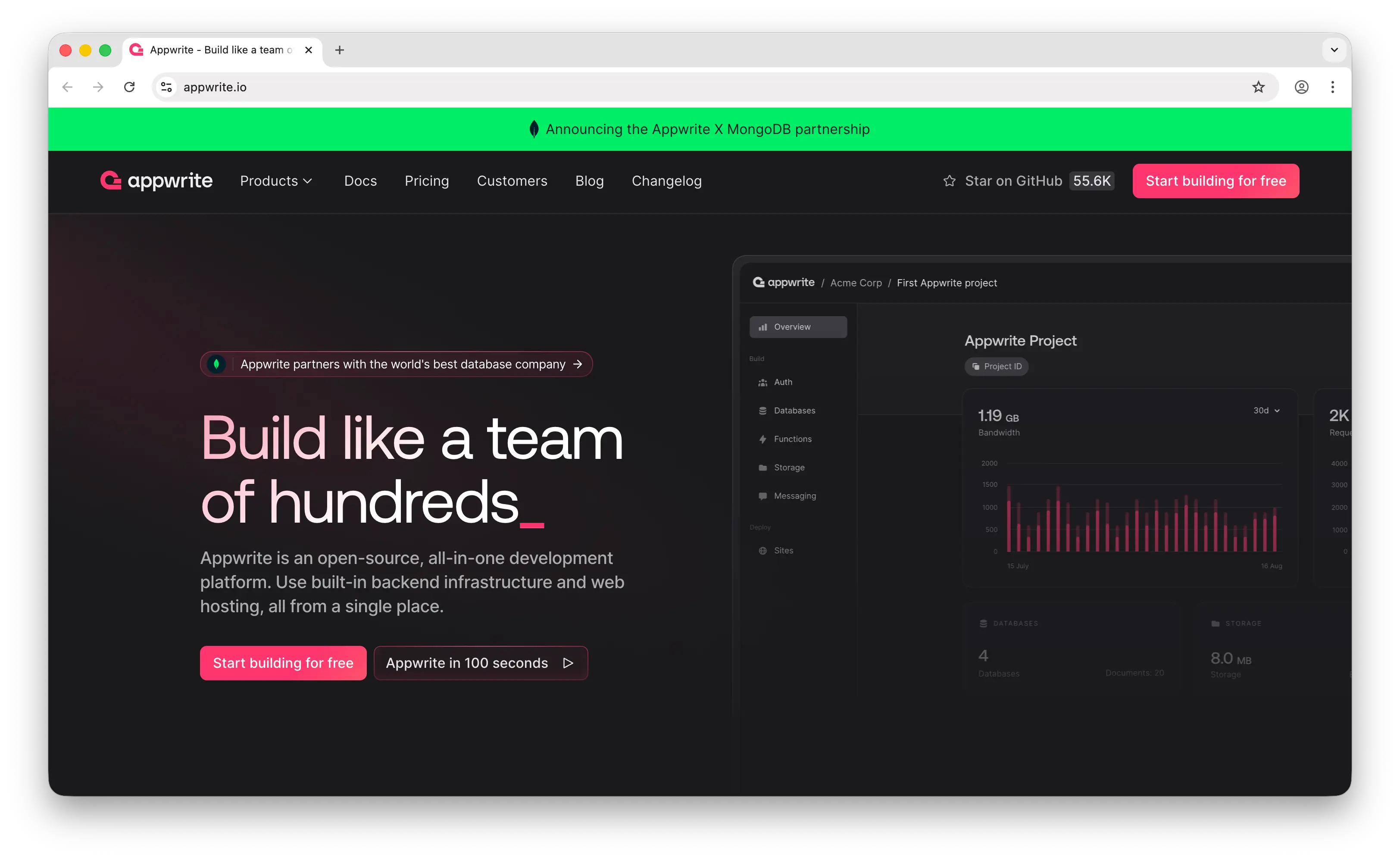
Appwrite is an open-source backend server packaged as Docker microservices. You get a document database, auth with 30+ login methods, file storage with image transformation, serverless functions in 15+ runtimes, real-time subscriptions, messaging, and hosting — all self-hostable on your own infrastructure, or as a managed Appwrite Cloud service.
What Makes It Different
Appwrite is the most complete all-in-one BaaS on this list. It includes built-in messaging (push notifications, SMS, email), image transformation on file storage, Sites for hosting (with SSR support), and Functions that run in 15+ language runtimes — Node, Python, Ruby, PHP, Dart, Go, .NET, Swift, Kotlin, and more. Convex is a focused TypeScript platform: it doesn't ship messaging, hosting, or image transforms, and your server functions are TypeScript-only.
Multi-platform SDK support is another big advantage. Appwrite has first-class SDKs for Web, iOS native, Android native, Flutter, React Native, Apple, Node.js, Python, Dart, .NET, and more. Convex's strongest story is TypeScript on the web; mobile and non-TS clients are supported but secondary.
The license is also cleaner. Appwrite is BSD-3-Clause — one of the most permissive open-source licenses around. Convex uses FSL-1.1-Apache-2.0, which adds competitive-use restrictions until a delayed Apache grant takes effect. For teams that need a clean license for compliance or want to fork freely, this matters.
Key Differences from Convex
Convex's reactive query model is fundamentally more elegant for real-time apps. Every Convex query is a live subscription by default, and the database engine tracks dependencies automatically — when a row changes, every query watching it re-runs and pushes updates to clients. Appwrite has real-time through WebSocket subscriptions, but they're opt-in per channel and operate at the document level rather than the query level. For collaborative or multiplayer features, Convex requires less code.
End-to-end type safety is another Convex strength. Your schema, queries, mutations, and client code all share types automatically without code generation. Appwrite's SDKs are well-built but don't offer the same compile-time guarantees across the boundary.
ACID transactions are also different. Every Convex mutation is fully serializable and transactional by default — no partial writes, no inconsistent state. Appwrite added transaction support in v1.8 but it's opt-in rather than the default.
Comparison Table
| Feature | Appwrite | Convex |
|---|---|---|
| Database type | Document database (MariaDB) | Reactive document database |
| Query model | REST / GraphQL API | TypeScript functions (reactive) |
| Real-time | WebSocket subscriptions |
Automatic on every query |
| ACID transactions | Opt-in (v1.8+) | Default on all mutations |
| Type safety | Partial (via SDKs) | End-to-end TypeScript |
| Authentication | 30+ methods |
|
| Cloud storage | + image transformation |
|
| Push notifications | |
|
| Function runtimes | 15+ runtimes |
TypeScript/JavaScript only |
| Image transformation | |
|
| Hosting (Sites) | SSR + custom domains |
|
| Vector search | |
|
| Mobile SDKs | Native iOS, Android, Flutter |
React Native, limited native |
| Pricing model | Free (self-hosted) or Cloud plans | $25/mo Pro, usage-based |
| License | BSD-3-Clause |
FSL-1.1-Apache-2.0 |
| Self-hostable | Mature Docker deployment |
Newer |
| Community size | ~55K GitHub stars | ~11K GitHub stars |
| Best for | Self-hosted apps needing multi-platform SDKs and all-in-one features | Real-time collaborative apps with TypeScript-first DX |
Which Should You Choose?
Choose Puter.js if you want zero-cost, zero-config simplicity with built-in AI. Drop in a script tag and get auth, storage, database, and 500+ AI models with no backend, no API keys, and no infrastructure bill regardless of how many users you have. Ideal for AI-powered web apps where the User-Pays model fits your distribution.
Choose Supabase if you need full SQL and relational modeling. PostgreSQL gives you joins, full-text search, RLS, JSONB, and pgvector — plus your queries are portable to any Postgres provider. The largest open-source community in BaaS and a clean Apache 2.0 license.
Choose Firebase if you're building a mobile-first app that needs best-in-class offline sync, push notifications, analytics, and crash reporting in one place. Accept the vendor lock-in and pay-per-read pricing as the cost of a deeply mature mobile platform.
Choose AWS Amplify if you're already on AWS or know you'll need the long tail of AWS services eventually. The code-first Gen 2 DX is comparable to Convex, but you also get a direct path to 200+ AWS services through the CDK escape hatch.
Choose Appwrite if you want full data sovereignty and the most complete self-hostable BaaS. Multi-language function runtimes, native mobile SDKs, built-in messaging, image transformation, and Sites hosting — all under a clean BSD-3-Clause license.
Stick with Convex if real-time reactivity is the core of your app and you want a TypeScript-first developer experience with automatic sync, ACID transactions by default, and end-to-end type safety. Best for collaborative apps, multiplayer features, and live dashboards where the reactive query model pays for itself.
Conclusion
The top 5 Convex alternatives are Puter.js, Supabase, Firebase, AWS Amplify, and Appwrite. Each takes a different approach to backend-as-a-service: Puter.js eliminates the backend entirely with the User-Pays model and built-in AI, Supabase gives you the full power of PostgreSQL with a clean license, Firebase dominates mobile with best-in-class offline sync, AWS Amplify opens the door to the entire AWS ecosystem, and Appwrite delivers the most complete self-hostable platform. The best choice depends on whether you need SQL or reactive queries, where you want your data to live, and how much you're willing to pay as your app scales.
Related
- Getting Started with Puter.js
- Top 5 Supabase Alternatives (2026)
- Top 5 Firebase Alternatives (2026)
- Best Appwrite Alternatives (2026)
- Top 5 PocketBase Alternatives (2026)
- Top 5 Xano Alternatives (2026)
- Top 5 DynamoDB Alternatives (2026)
- Top 5 MongoDB Alternatives (2026)
- Top 5 PostgreSQL Alternatives (2026)
- Top 5 Neon Alternatives (2026)
- Top 5 PlanetScale Alternatives (2026)
- Top 5 Turso Alternatives (2026)
- Top 5 AWS Amplify Alternatives (2026)
- Best Back4App Alternatives (2026)
Ship a Full-Stack App with One Prompt
Create a to-do list app using Puter.js
Coding manually? see the guide