Top 5 PlanetScale Alternatives (2026)
On this page
PlanetScale built its reputation on bringing git-like workflows to databases — branching, deploy requests, and zero-downtime schema changes layered on top of MySQL (via Vitess) and Postgres, with NVMe-backed "Metal" performance for production workloads at scale. It's a strong product, but the removal of its free tier in 2024 and a pricing model tuned for serious infrastructure have left plenty of developers wondering what else is out there.
This article walks through five PlanetScale alternatives — each solving a different slice of the same problem — and where each one fits better.
1. Puter.js
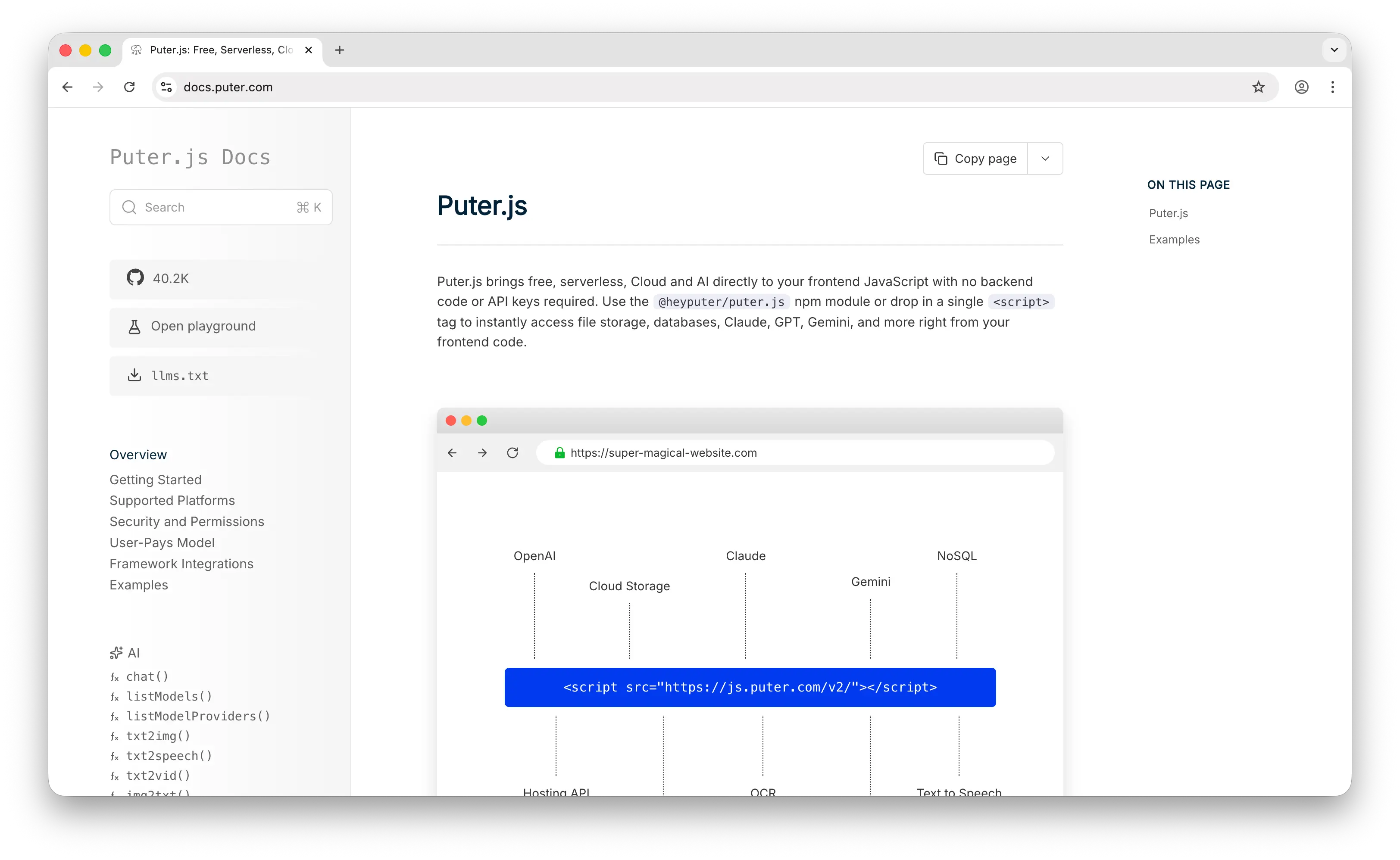
Puter.js takes a different approach to the "managed database" problem. Instead of provisioning a cluster and connecting to it from a backend, you drop a single <script> tag into your frontend and call puter.kv.set() and puter.kv.get() directly from the browser. The same library also gives you authentication, file storage, AI access, and static hosting — the database is just one piece of the stack.
What Makes It Different
The economics are flipped. Where PlanetScale bills the developer for every cluster, branch, and gigabyte of storage, Puter.js routes infrastructure costs to the end user. When someone signs into your app, their Puter account covers their own usage — storage, compute, AI, all of it. Puter calls this the User-Pays Model, and the practical effect is that a Puter.js app costs the developer $0 to run whether it has one user or a million.
The scope is also wider than a database. Authentication, S3-style object storage, 500+ AI models, and static site hosting all live in the same library. Building the equivalent on PlanetScale means signing up for a separate auth provider, a separate file store, and a separate hosting platform — and paying each one independently.
Key Differences from PlanetScale
Puter.js is primarily a frontend library — it works in Node.js and Serverless Workers, but the user-pays model only makes sense when your end users are the ones signing in. It's also a NoSQL key-value store, so there are no joins, transactions, or relational schema migrations. For internet-scale relational workloads with horizontal sharding via Vitess, PlanetScale is still the stronger fit.
Comparison Table
| Feature | Puter.js | PlanetScale |
|---|---|---|
| Pricing model | User-pays (free for devs) | Resource-based (cluster + storage) |
| Free tier |  (developer pays $0) (developer pays $0) |
 (removed in 2024) (removed in 2024) |
| Starting price | Free | $5/month |
| Database type | NoSQL key-value | MySQL (Vitess) + Postgres |
| Backend required | |
|
| Connection strings | |
|
| Branching | |
(deploy requests) |
| Horizontal sharding | |
(Vitess) |
| SQL queries / joins | |
|
| Built-in auth | |
|
| File storage | |
|
| AI integration | (400+ models) |
|
| Static hosting | |
|
| Open-source | |
|
| Best for | Frontend/web app devs who want zero-cost cloud data | High-scale production SQL workloads |
2. Neon
Neon is a serverless Postgres platform that separates storage from compute. It's the closest spiritual sibling to PlanetScale in the alternatives list, both pioneered git-style database branching, both rearchitected the underlying storage layer, and both target modern developer workflows.
What Makes It Different
Neon implements true scale-to-zero: when your database is idle, your compute cost drops to $0, and a new connection wakes the instance in roughly 300–500ms. PlanetScale clusters bill per second whether you're using them or not. Neon also offers instant copy-on-write branching: creating a branch takes under a second regardless of database size, and a child branch within the restore window costs nothing extra in storage.
Neon was acquired by Databricks for approximately $1 billion in May 2025, which significantly reduced vendor risk concerns. After the acquisition, storage pricing dropped from $1.75 to $0.35 per GB-month and free tier compute doubled to 100 CU-hours.
Key Differences from PlanetScale
Neon is Postgres-only. If you're committed to MySQL, it's not a direct alternative. Neon also does not offer horizontal sharding the way PlanetScale's Vitess engine does, so for true internet-scale workloads with hundreds of terabytes, PlanetScale's Metal tier still wins on raw performance. Neon's branching uses copy-on-write while PlanetScale uses a deploy-request workflow with explicit schema review, the two are similar in spirit but different in operational feel.
Comparison Table
| Feature | Neon | PlanetScale |
|---|---|---|
| Pricing model | Usage-based (compute + storage) | Resource-based (cluster + storage) |
| Free tier | (100 CU-hrs, 0.5GB) |
|
| Starting paid price | $5/month | $5/month |
| Database type | Postgres | MySQL (Vitess) + Postgres |
| Branching | (copy-on-write, instant) |
(deploy requests) |
| Scale-to-zero | (~300–500ms wake) |
|
| Horizontal sharding | |
(Vitess) |
| Foreign keys | |
|
| Connection pooling | (PgBouncer) |
|
| NVMe storage option | |
(Metal) |
| Point-in-time recovery | (up to 30 days) |
|
| Postgres extensions | (80+) |
Limited |
| Open-source | (Apache 2.0) |
|
| Self-hostable | |
|
| Best for | Variable workloads, branching per PR | Steady-state high-perf production workloads |
3. Supabase
Supabase is an open-source backend-as-a-service built on Postgres. While PlanetScale focuses on being the best managed database, Supabase wraps a Postgres instance with everything else you need to ship a full-stack app.
What Makes It Different
Supabase bundles Postgres + Authentication + Storage + Realtime + Edge Functions + Vector embeddings + auto-generated REST and GraphQL APIs into a single platform. With PlanetScale you'd separately add Auth0 or Clerk for auth, S3 or R2 for files, Pusher or Ably for realtime, and Vercel or AWS Lambda for serverless functions. Supabase replaces all of that with one project.
It also has a genuinely useful free tier: 500MB database, 1GB storage, 50,000 monthly active users, and unlimited API requests. Pro is $25/month, which includes 100,000 MAU and 8GB database, an order of magnitude cheaper than equivalent Firebase or AWS Amplify usage.
Key Differences from PlanetScale
Supabase is Postgres-only and does not offer horizontal sharding, so it's not a fit for workloads that need to shard across hundreds of nodes the way PlanetScale's Vitess engine does. It also doesn't have PlanetScale's NVMe Metal performance tier, performance is comparable to a standard managed Postgres rather than a tuned, dedicated cluster. If you only need a database, not a full BaaS, you're paying for features you won't use.
Comparison Table
| Feature | Supabase | PlanetScale |
|---|---|---|
| Pricing model | Tiered + usage | Resource-based |
| Free tier | (500MB DB, 50k MAU) |
|
| Starting paid price | $25/month | $5/month |
| Database type | Postgres | MySQL (Vitess) + Postgres |
| Branching | (GitHub-based) |
(deploy requests) |
| Horizontal sharding | |
(Vitess) |
| Built-in auth | |
|
| Row Level Security | |
|
| Realtime subscriptions | |
|
| File storage | (S3-compatible) |
|
| Edge functions | (Deno) |
|
| Auto-generated APIs | (REST + GraphQL) |
|
| Vector / pgvector | |
|
| Open-source | |
|
| Self-hostable | |
|
| Best for | Full-stack SaaS needing bundled backend | Database-only, high-scale SQL |
4. Firebase
Firebase is Google's backend-as-a-service platform, best known for Firestore (a NoSQL document database) and the Realtime Database (a JSON tree store). It's the platform that originally defined what "backend for mobile apps" means.
What Makes It Different
Firebase is mobile-first in a way PlanetScale isn't. The client SDKs for iOS, Android, Flutter, and the web include offline persistence and automatic realtime sync: data changes on the server stream to the client instantly, and writes made while offline are queued and synced when connectivity returns. PlanetScale assumes you have a backend that talks to it over a SQL connection, there's no equivalent client SDK story.
In late 2024 Firebase added Data Connect, which gives you a SQL path backed by Cloud SQL Postgres with a schema-driven approach and generated SDKs. So Firebase is no longer NoSQL-only, but Firestore is still the default for most apps.
Key Differences from PlanetScale
Firebase's primary databases are NoSQL document stores, which struggle with relational data: joins typically require multiple queries stitched client-side or denormalized data. PlanetScale gives you full SQL with joins, transactions, and foreign-key-style constraints (via app-level enforcement). Firebase's pay-per-operation pricing can also spike unpredictably at scale, every document read and write is billed, which is why high-traffic apps frequently see surprise bills.
Comparison Table
| Feature | Firebase | PlanetScale |
|---|---|---|
| Pricing model | Pay-per-operation | Resource-based (cluster + storage) |
| Free tier | (Spark plan) |
|
| Starting paid price | Pay-as-you-go (Blaze) | $5/month |
| Database type | NoSQL (Firestore + RTDB) + Postgres via Data Connect | MySQL (Vitess) + Postgres |
| Branching | |
|
| Horizontal sharding | Auto (Firestore) | (Vitess) |
| Joins / relational queries | Limited (client-stitching) | (full SQL) |
| Built-in auth | |
|
| Realtime sync | (best-in-class) |
|
| Offline support | (mobile SDKs) |
|
| File storage | (Cloud Storage) |
|
| Cloud functions | |
|
| Mobile SDKs | (iOS/Android/Flutter) |
|
| Predictable pricing | (operation-based) |
|
| Open-source | |
|
| Best for | Mobile apps with realtime + offline | High-scale relational SQL workloads |
5. DynamoDB
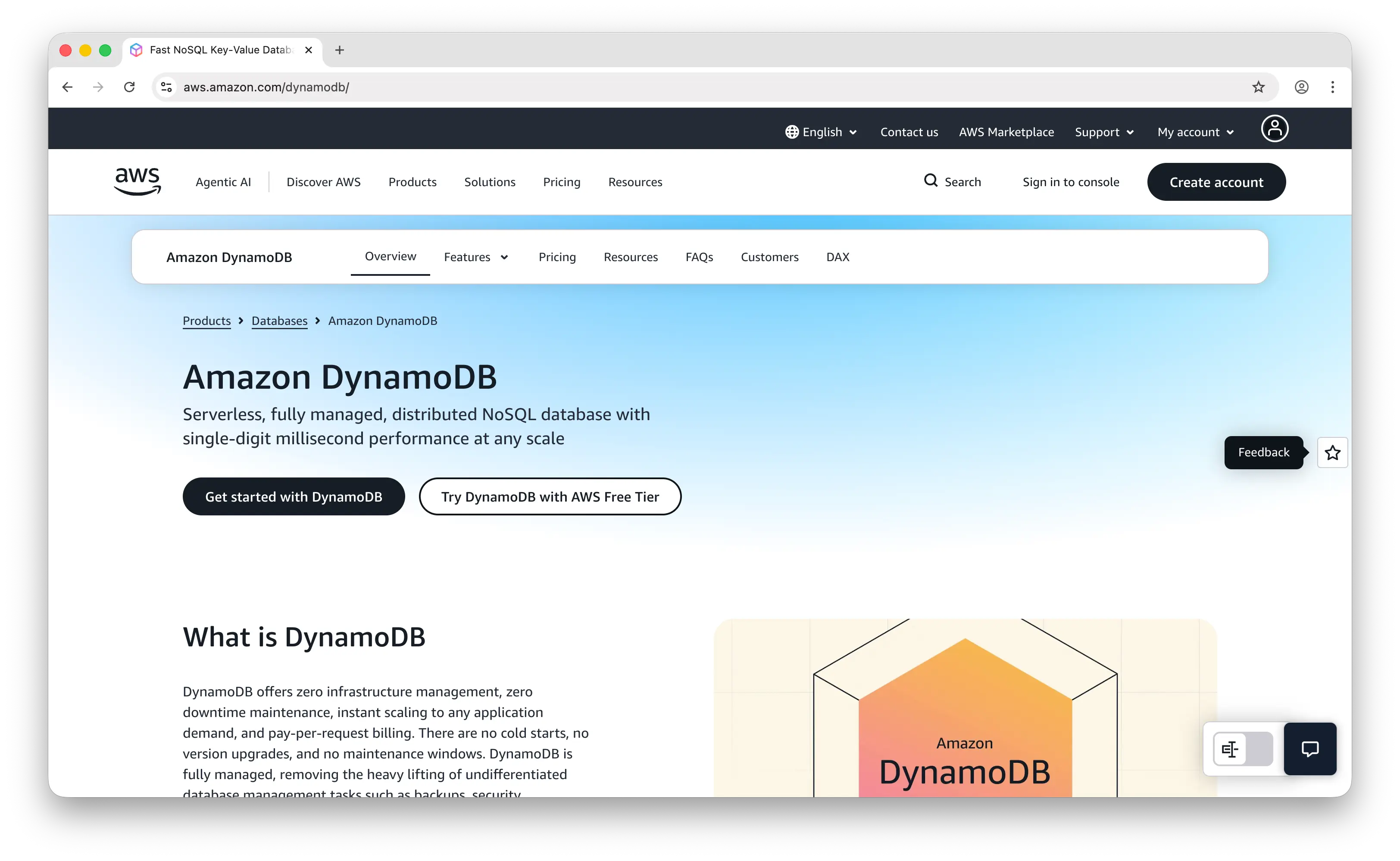
Amazon DynamoDB is AWS's serverless NoSQL key-value and document database. It's been the backbone of Amazon.com itself for over a decade, including the shopping cart during Prime Day, so it's battle-tested at internet scale in a way few alternatives can claim.
What Makes It Different
DynamoDB delivers single-digit millisecond performance at any scale, with zero infrastructure management, zero downtime maintenance, and pay-per-request billing. It has no cold starts, no version upgrades, and no maintenance windows. Global tables offer multi-region active-active replication with 99.999% availability and multi-region strong consistency, enabling zero-RPO applications. DynamoDB Streams capture every item-level change for event-driven architectures, and the integration with the rest of the AWS ecosystem (Lambda, API Gateway, Step Functions, AppSync) is deeper than any third-party database can match.
In November 2024, AWS reduced on-demand throughput pricing by 50% and global tables pricing by up to 67%, making it more cost-competitive than ever.
Key Differences from PlanetScale
DynamoDB is NoSQL key-value, not relational, so there's no SQL, no joins (PartiQL has limited support), and no foreign keys. It also enforces a single-table design mental model that has a real learning curve, you architect around access patterns, not around normalized entities. There's no branching workflow, no schema review process, and no equivalent of PlanetScale's deploy requests. And while DynamoDB is "open" in terms of API, it's tightly coupled to AWS, you can't self-host or move it to another cloud easily.
Comparison Table
| Feature | DynamoDB | PlanetScale |
|---|---|---|
| Pricing model | Per-request or provisioned | Resource-based (cluster + storage) |
| Free tier | (25GB perpetual) |
|
| Database type | NoSQL key-value / document | MySQL (Vitess) + Postgres |
| Latency | Single-digit ms at any scale | Single-digit ms (Metal) |
| Scale-to-zero | (on-demand mode) |
|
| Branching | |
|
| Horizontal sharding | Automatic | (Vitess) |
| Multi-region replication | (active-active, 99.999%) |
Read-only regions |
| SQL queries | PartiQL (limited) | (full SQL) |
| Joins | |
|
| Streams / CDC | (DynamoDB Streams) |
|
| Cold starts | |
|
| In-memory cache | (DAX) |
|
| AWS ecosystem integration | Native (Lambda, API Gateway, etc.) | |
| Open-source / portable | |
|
| Best for | AWS-native serverless apps with key-value access | Relational SQL with branching workflows |
Which Should You Choose?
Choose Puter.js if you're building a web app and want cloud data, auth, storage, and AI without any backend, API keys, or infrastructure bill. The user-pays model is ideal for developers who don't want to cover user costs, especially apps where you can't predict scale.
Choose Neon if you want serverless Postgres with true scale-to-zero and instant branching for every PR. It's the closest direct alternative to PlanetScale's developer workflow, and with the Databricks acquisition it has long-term backing.
Choose Supabase if you need a full backend, not just a database. Postgres + auth + storage + realtime + edge functions in one platform saves you from stitching together five services. The generous free tier and $25 Pro plan make it especially attractive for early-stage projects.
Choose Firebase if you're shipping a mobile app where realtime sync and offline support are core to the experience. The mobile SDKs are mature in a way nothing else on this list is, and the Google Cloud integration is hard to beat.
Choose DynamoDB if you're all-in on AWS, your access patterns are key-value, and you need ruthless consistency under extreme load. It's the right answer for serverless workloads on Lambda where SQL flexibility isn't a requirement.
Stick with PlanetScale if you need MySQL with horizontal sharding via Vitess, NVMe-backed performance for write-heavy workloads, or the deploy-request workflow for schema changes on large production databases. It remains the strongest pure-database choice for high-scale relational SQL.
Conclusion
The top 5 PlanetScale alternatives are Puter.js, Neon, Supabase, Firebase, and DynamoDB. Each takes a different approach to making data infrastructure accessible, from Puter.js's zero-cost frontend integration to Neon's scale-to-zero Postgres to DynamoDB's AWS-native key-value store. Whichever platform you choose, the best option is the one that fits your stack, your budget, and how your users will interact with data in your app.
Related
- Getting Started with Puter.js
- How to Use Puter.js Key-Value Store API
- Add a Key-Value Store to Your App: A Free Alternative to DynamoDB
- Top 5 PostgreSQL Alternatives (2026)
- Top 5 Neon Alternatives (2026)
- Top 5 Supabase Alternatives (2026)
- Top 5 Firebase Alternatives (2026)
- Top 5 DynamoDB Alternatives (2026)
- Top 5 MongoDB Alternatives (2026)
- Best Appwrite Alternatives (2026)
- Best Convex Alternatives (2026)
- Top 5 PocketBase Alternatives (2026)
- Top 5 Redis Alternatives (2026)
- Top 5 Upstash Alternatives (2026)
- Top 5 Memcached Alternatives (2026)
- Top 5 Amazon S3 Alternatives (2026)
- Top 5 Turso Alternatives (2026)
Ship a Full-Stack App with One Prompt
Create a to-do list app using Puter.js
Coding manually? see the guide