Top 5 Backblaze B2 Alternatives (2026)
On this page
Backblaze B2 built its reputation on one number: $6 per TB per month. It's S3-compatible, ships with free egress up to 3× your monthly average storage, and through the Bandwidth Alliance offers unlimited free egress to Cloudflare, Fastly, and bunny.net. For bulk storage, backups, and media delivery behind a CDN, the economics are tough to beat.
But B2 is still infrastructure. You need a Backblaze account, application keys, bucket configuration, and a backend or Worker to handle uploads and signed URLs safely from the client. The feature surface beyond raw storage is intentionally narrow — no auth, no database, no AI, no edge compute — and outside the Bandwidth Alliance you're locked into B2's CDN partners to keep egress free. Here are five alternatives that take different approaches — from zero-config client-side storage to enterprise cloud platforms.
1. Puter.js
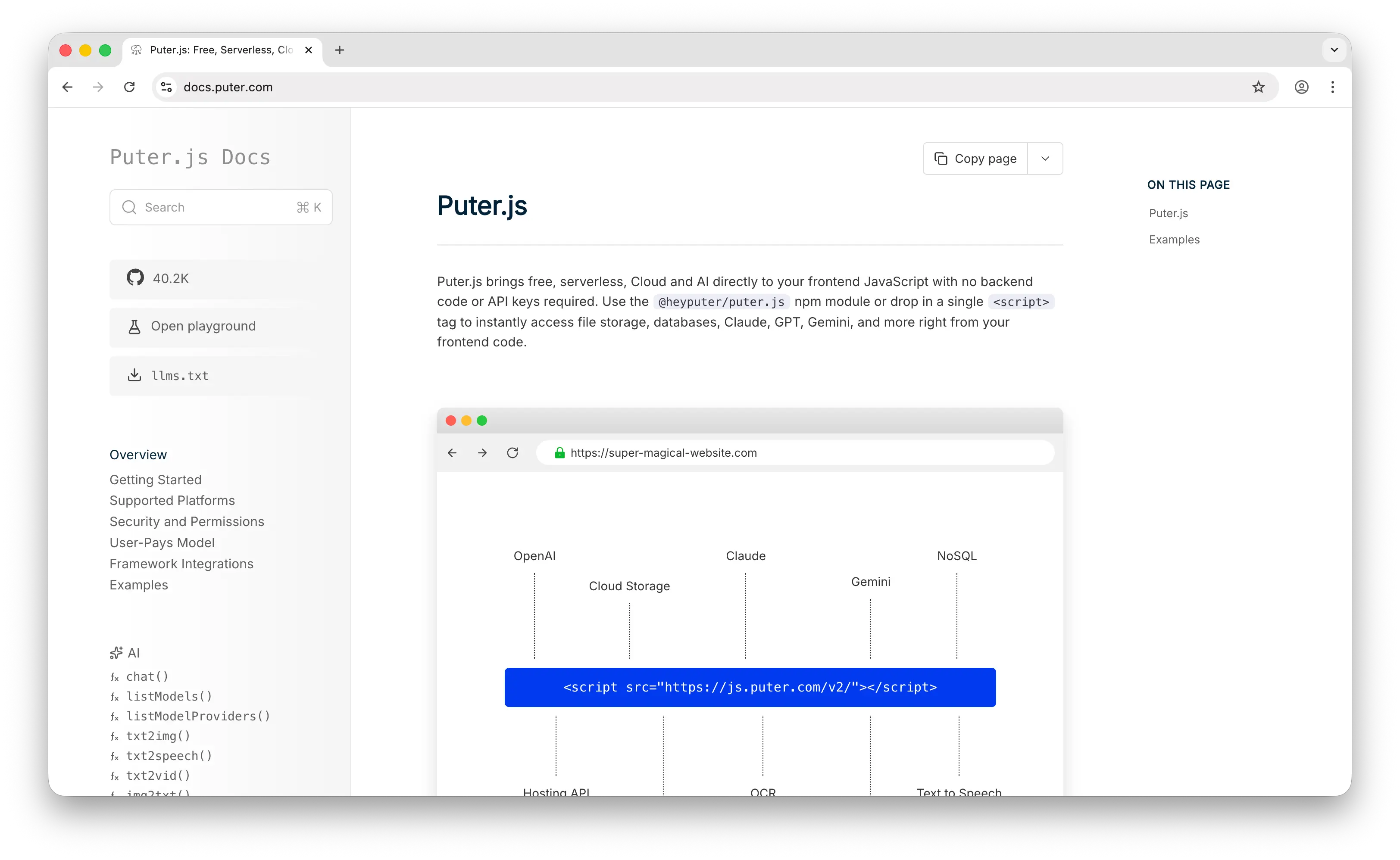
Puter.js is a client-side JavaScript library that gives you cloud storage, auth, a database, and 500+ AI models without deploying or configuring any backend. Where B2 requires a Backblaze account, application keys, bucket setup, and typically a backend service to handle uploads and signed URLs, Puter.js is a script tag and a few lines of JavaScript.
What Makes It Different
Add Puter.js and you're storing files. No Backblaze account to create, no dashboard to navigate, no application keys to generate, no server to deploy for upload authorization. The API mirrors local file operations — puter.fs.write('photo.png', file) — instead of making you think in buckets, S3-compatible endpoints, and capability tokens.
Puter.js runs entirely client-side. No server code, no SDK initialization, no environment variables. Your frontend is your storage layer. It also uses the User-Pays Model: your app's users cover their own storage through their Puter account. Whether your app has 10 users or 10 million, your infrastructure cost stays at zero. B2 is genuinely cheap at $6/TB — but it's still pay-as-you-go, and you still own the bill.
Puter is open-source (AGPL-3.0) and privacy-focused — no tracking, no data monetization. Auth, key-value database, and AI come bundled in the same library, so you don't need to wire B2 up to a separate auth provider, database, and AI gateway to ship a full app.
Key Differences from B2
Puter.js has no S3-compatible API, no native backup tool integration (Veeam, rclone, Cloudberry), no object lock, no immutability, and no archival tier. You can't point existing S3 tooling at it, run server-to-server backup jobs, or hold data under WORM for compliance. B2 wins decisively for backup workloads, media archives, and any pipeline where the data flows server-to-server. Puter.js wins for teams that want to skip the infrastructure layer entirely and ship features.
Comparison Table
| Feature | Puter.js | Backblaze B2 |
|---|---|---|
| Setup time | Minutes (one script tag) | 30–60 minutes (account, keys, bucket, backend) |
| API key required | No | Yes |
| Backend required | No | Usually (for upload auth and signed URLs) |
| Pricing model | User-pays (free for devs) | Pay-as-you-go ($6/TB stored) |
| Free tier | Unlimited (user-pays) | 10 GB storage |
| Egress cost | Free (user-pays) | Free up to 3× monthly storage, then $0.01/GB |
| S3-compatible API |  |
 |
| Object Lock / WORM | |
|
| Backup tool integration | |
(Veeam, rclone, Cyberduck, etc.) |
| Built-in auth | |
|
| Built-in database | |
|
| Built-in AI | (400+ models) |
|
| Open source | |
|
| Best for | Frontend devs who want zero-cost storage with no backend | Bulk storage, backups, CDN-fronted media |
2. Amazon S3
Amazon S3 is the original object storage service and the API that B2 (and most alternatives) are compatible with. It's the most feature-rich option on this list, with the deepest ecosystem and the highest egress costs.
What Makes It Different
S3 has 18+ years of development behind it — eight storage classes (Standard, Intelligent-Tiering, Standard-IA, One Zone-IA, Glacier Instant, Glacier Flexible, Glacier Deep Archive, Express One Zone), versioning, Object Lambda, S3 Select, Storage Lens, Batch Operations, and Object Lock. B2 has effectively one hot tier plus the newer B2 Overdrive ($15/TB) for high-throughput AI/ML workloads, and a much smaller feature surface.
S3 also has the broadest ecosystem of any object storage service on the planet. Nearly every cloud service, ETL tool, backup product, and analytics platform speaks S3 natively. If you're running compliance-heavy workloads (SOC 2, HIPAA, FedRAMP), S3's certifications and audit trails are unmatched. Glacier Deep Archive at $0.00099/GB is the cheapest archival storage available — B2's flat $0.006/GB rate can't compete for true cold data measured in years.
Key Differences from B2
The egress story is reversed. S3 charges $0.09/GB for the first 10 TB of internet egress per month, dropping to $0.085 and $0.07 at higher tiers. B2 includes free egress up to 3× your monthly average storage, then bills $0.01/GB — and unlimited free egress through Cloudflare, Fastly, and bunny.net via the Bandwidth Alliance. For a workload serving 5 TB/month to users on top of 1 TB stored, S3 costs around $450 in egress alone; B2 caps at $20 in egress (or $0 through Cloudflare). S3 is also nearly 4× more expensive per GB ($0.023 vs B2's $0.006) and bills across six separate dimensions — storage, requests, retrievals, egress, transitions, and management features — making cost forecasting much harder than B2's two-line bill.
Comparison Table
| Feature | Amazon S3 | Backblaze B2 |
|---|---|---|
| Setup time | Hours (AWS account, IAM, bucket config) | 30–60 minutes |
| Standard storage cost | $0.023/GB | $0.006/GB |
| Egress cost | $0.09/GB (first 10 TB) | Free up to 3× storage, then $0.01/GB |
| Free CDN egress | (CloudFront billed separately) |
(Bandwidth Alliance: Cloudflare, Fastly, bunny.net) |
| Free tier | None for new accounts (legacy tier ended July 2025) | 10 GB storage |
| S3-compatible API | (native) |
|
| Storage classes | 8 (Standard, IA, Glacier tiers, Express) | 1 hot tier (+ B2 Overdrive for throughput) |
| Lifecycle policies | (advanced) |
(basic) |
| Versioning | |
|
| Object Lock / WORM | |
|
| Cheapest archival | $0.00099/GB (Glacier Deep Archive) | $0.006/GB (single tier) |
| Compliance certs | SOC 2, HIPAA, FedRAMP, ISO 27001 | SOC 2 Type II, HIPAA, ISO 27001 |
| Ecosystem | Broadest (200+ AWS services, every major tool) | Backup-focused (Veeam, rclone, NAS vendors, MSPs) |
| Pricing complexity | Very high (6 billing dimensions) | Low (2 line items) |
| Best for | Enterprise workloads, deep archival, AWS-native pipelines | Cheap bulk storage, backups, CDN-fronted delivery |
3. Wasabi
Wasabi is B2's most direct competitor — a budget-focused, S3-compatible object storage service aimed at backup, archive, and media workloads. The pitch is the same as B2's: flat-rate storage, no surprise fees, undercut the hyperscalers.
What Makes It Different
Wasabi's headline feature is a single flat rate of $6.99/TB/month (rising to $7.99/TB on July 1, 2026) with no per-request fees and no egress fees within fair-use limits. There are no Class A or Class B operation charges, no retrieval fees, and no charges for PUT, GET, LIST, or DELETE calls. B2 charges fractions of a cent per 10,000 transactions and bills egress beyond the 3× allowance — Wasabi simplifies that away entirely if you fit inside the policy.
Wasabi also runs the same flat rate across all 13+ global regions, which is useful if you need data in Frankfurt or Singapore without paying a regional premium. Like B2, it's fully S3-compatible, so existing tooling (rclone, Veeam, Cyberduck, Restic) works without modification.
Key Differences from B2
The fine print matters. Wasabi has a 1 TB minimum billing floor — store 100 GB and you still pay $6.99/month, an effective rate of $0.069/GB that's 10× the headline price and worse than even S3. B2 has no such minimum: pay $0.006/GB on whatever you actually store, with the first 10 GB free. Wasabi also enforces a 90-day minimum storage duration; delete or overwrite within that window and you still pay through day 90. B2 has no minimum retention period. Wasabi's "free egress" is bounded by a 1:1 monthly egress-to-storage ratio and a 100 TB ceiling; B2's free egress allowance is 3:1, and Bandwidth Alliance egress is genuinely unlimited. For most small-to-mid workloads, B2 ends up cheaper and more flexible despite the very similar headline price.
Comparison Table
| Feature | Wasabi | Backblaze B2 |
|---|---|---|
| Setup time | 30–60 minutes | 30–60 minutes |
| Storage cost | $6.99/TB ($0.0069/GB), rising to $7.99/TB July 2026 | $6/TB ($0.006/GB) |
| Egress cost | Free (1:1 storage ratio, 100 TB cap) | Free up to 3× storage, then $0.01/GB |
| Free CDN egress | |
(Bandwidth Alliance) |
| API request fees | (free) |
Small per-1,000-calls fee |
| Free tier | 30-day trial | 10 GB storage permanently free |
| Minimum billing | 1 TB ($6.99/month floor) | None |
| Minimum retention | 90 days | None |
| S3-compatible API | |
|
| Object Lock / WORM | |
|
| Storage classes | 1 (hot only) | 1 hot tier (+ B2 Overdrive) |
| Built-in auth | |
|
| Open source | |
|
| Best for | Stable multi-TB workloads with predictable egress patterns | Sub-TB to multi-PB storage with CDN-fronted delivery |
4. Firebase Storage
Firebase Storage (Cloud Storage for Firebase) is Google's managed file storage for mobile and web apps. It wraps Google Cloud Storage in a developer-friendly SDK with built-in security rules and strong mobile support.
What Makes It Different
Firebase's real strength is its mobile SDKs — first-class support for iOS, Android, and web with built-in retry, offline handling, and progress monitoring. Security rules are declarative and straightforward: you write rules like "allow read if user is authenticated" in a config file. B2 has none of this — for auth you write a backend that issues short-lived download tokens, for offline upload retries you build it yourself, for mobile SDKs you use a third-party S3-compatible client pointed at the B2 endpoint.
If you're already using Firebase Auth and Firestore, adding Firebase Storage is essentially free integration work. B2 stands alone as object storage; you build the rest.
Key Differences from B2
The pricing model is fundamentally hostile to bandwidth-heavy workloads. Firebase Storage costs $0.026/GB for storage and charges around $0.12/GB for egress — every download counts. An image-heavy app storing 100 GB and serving 1 TB/month pays roughly $123/month on Firebase. The same workload on B2 pays $0.60 for storage, includes 300 GB of free egress (3× 100 GB stored), and then pays $0.01/GB for the remaining ~700 GB of egress — roughly $7.60/month total. You'd need about 333 GB stored to cover 1 TB of egress for free. Even in the worst case, B2 is cheaper by more than an order of magnitude. Firebase is also not S3-compatible, so migrating to or from it means rewriting your storage layer, and there are no spending caps — a viral app or a runaway bug can spike your bill into the thousands in a single day.
Comparison Table
| Feature | Firebase Storage | Backblaze B2 |
|---|---|---|
| Setup time | 15–20 minutes | 30–60 minutes |
| Storage cost | $0.026/GB | $0.006/GB |
| Egress cost | ~$0.12/GB | Free up to 3× storage, then $0.01/GB |
| Free CDN egress | |
(Bandwidth Alliance) |
| Free tier | 5 GB storage, 1 GB egress/day (Blaze plan required for prod) | 10 GB storage |
| Spending caps | (manual budget alerts only) |
(manual budget alerts only) |
| S3-compatible API | |
|
| Security rules | Declarative config (simple) | Manual via backend (custom code) |
| Mobile SDKs | Excellent (iOS, Android, web) |
(use S3 SDK with B2 endpoint) |
| Offline handling | Built-in |
|
| Storage classes | |
1 hot tier (+ B2 Overdrive) |
| Backup tool integration | |
(Veeam, rclone, NAS vendors) |
| Built-in auth integration | (Firebase Auth) |
|
| Vendor lock-in | High (Google ecosystem) | Low (S3-compatible, standard tooling) |
| Best for | Mobile/web apps already on Firebase | Cheap bulk storage, backups, CDN delivery |
5. Supabase Storage
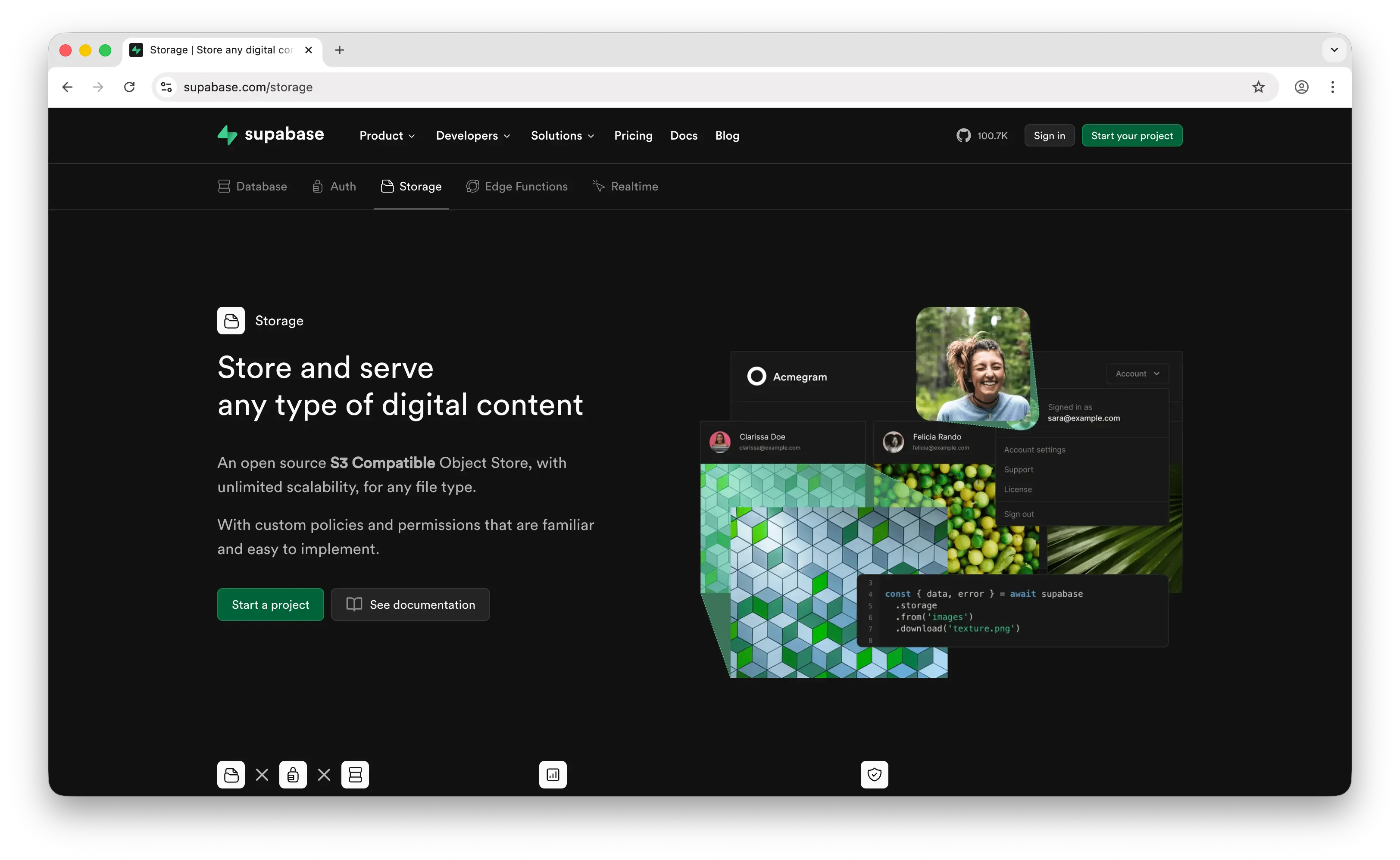
Supabase Storage is an open-source file storage service built on AWS S3, wrapped in a friendlier SDK with Postgres-based access control. If you're already using Supabase for your database and auth, adding storage is a natural extension.
What Makes It Different
Supabase integrates auth tightly with storage — you can write Row Level Security (RLS) policies like "users can only read their own files" directly in SQL. B2 has no equivalent; you handle auth in a backend service, which means writing and maintaining your own permission code. Supabase also offers built-in image transformations — resize, crop, and format-convert images via URL parameters. B2 requires a separate image service or a Worker/Lambda in front of the bucket to do the same thing.
Supabase Storage is S3-compatible, so it can be a drop-in replacement for B2 from a tooling perspective. And because it's open source, you can self-host the entire Supabase stack — something B2, Wasabi, and most other entries on this list don't offer.
Key Differences from B2
Pricing is bundle-based rather than purely per-GB. The free tier is tight at 1 GB storage and 5 GB egress, and free projects pause after a week of inactivity. The Pro plan at $25/month includes 100 GB storage and 250 GB egress, with overages at $0.021/GB storage and $0.09/GB egress. B2 is pure pay-as-you-go with no platform fee — at 100 GB stored, you pay $0.60/month versus Supabase's $25 floor. For raw bulk storage and bandwidth-heavy delivery, B2 is dramatically cheaper. Supabase wins when your storage is tightly coupled to a Postgres database and you want RLS to govern both data and files in one place.
Comparison Table
| Feature | Supabase Storage | Backblaze B2 |
|---|---|---|
| Setup time | 20–30 minutes | 30–60 minutes |
| Pricing model | Free tier + Pro ($25/month) + overages | Pure pay-as-you-go (no platform fee) |
| Storage cost | $0.021/GB (overages on Pro) | $0.006/GB |
| Egress cost | $0.09/GB (over included quota) | Free up to 3× storage, then $0.01/GB |
| Free CDN egress | |
(Bandwidth Alliance) |
| Free tier | 1 GB storage, 5 GB egress | 10 GB storage |
| Free tier inactivity | Projects pause after 7 days | No pausing |
| Platform minimum | $25/month for production use | $0 (pure usage-based) |
| S3-compatible API | |
|
| Access control | RLS policies (SQL-based) | Manual via backend |
| Image transformations | Built-in |
(separate service) |
| Resumable uploads | (TUS protocol) |
(large file API) |
| Built-in auth integration | |
|
| Built-in database | (Postgres) |
|
| Open source / self-host | |
|
| Best for | Teams already on Supabase needing integrated storage | Cheap bulk storage, backups, CDN delivery |
Which Should You Choose?
Choose Puter.js if you're building a web app and want to store files without any backend, server code, or infrastructure costs. The user-pays model means you never have to think about storage bills regardless of scale — even compared to B2's $6/TB headline price, you're still managing application keys, upload authorization, and a backend, where Puter.js skips all of it.
Choose Amazon S3 if you need the deepest feature set, the broadest ecosystem, or the cheapest archival storage. Glacier Deep Archive at $0.00099/GB is unbeatable for true cold data, and S3's compliance certifications and tooling support are unmatched. Just be aware that egress costs can dwarf your storage bill for any delivery-heavy workload — exactly where B2 was designed to win.
Choose Wasabi if you have a stable, predictable, multi-terabyte workload and want a single flat rate with no operation fees to think about. Just be aware of the 1 TB minimum billing floor, the 90-day minimum retention, and the fair-use egress ratio that can trip up access-heavy use cases.
Choose Firebase Storage if you're building a mobile app and need excellent iOS/Android SDKs with built-in offline handling and retry logic. Just be aware of the lack of S3 compatibility and the steep $0.12/GB egress charges that make Firebase a poor fit for image- or video-heavy apps at any meaningful scale.
Choose Supabase Storage if you're already using Supabase for your database and auth. The integrated RLS policies and built-in image transformations are genuine advantages — and you can self-host if you need full control. The S3-compatible API also makes Supabase a credible direct alternative to B2 for app-integrated storage.
Stick with Backblaze B2 if your dominant need is cheap bulk storage with bandwidth-friendly egress — backups, NAS replication, video archives, media delivery behind Cloudflare. For server-to-server workloads, regulated backups with Object Lock, and any pipeline that already speaks S3, B2's $6/TB rate plus Bandwidth Alliance egress is hard to beat.
Conclusion
The top 5 Backblaze B2 alternatives are Puter.js, Amazon S3, Wasabi, Firebase Storage, and Supabase Storage. They range from zero-config client-side storage to enterprise cloud platforms, each trading off some of B2's bulk-storage economics for richer features, tighter app integration, or a fundamentally different cost model. The best choice depends on your stack: Puter.js for frontend-first apps with no backend, S3 for enterprise depth and deep archival, Wasabi for predictable flat-rate multi-TB workloads, Firebase or Supabase for apps that need auth-integrated storage.
Related
- Getting Started with Puter.js
- Top 5 Amazon S3 Alternatives (2026)
- Top 5 Cloudflare R2 Alternatives (2026)
- Top 5 Wasabi Alternatives (2026)
- Top 5 Firebase Alternatives (2026)
- Top 5 Supabase Alternatives (2026)
- Top 5 Filestack Alternatives (2026)
- Top 5 UploadThing Alternatives (2026)
- Best Appwrite Alternatives (2026)
Ship a Full-Stack App with One Prompt
Create a to-do list app using Puter.js
Coding manually? see the guide