Top 5 Cloudflare Workers Alternatives (2026)
On this page
Cloudflare Workers runs JavaScript and WASM inside V8 isolates across 330+ edge locations, delivering near-zero cold starts and low-latency global execution. But it draws hard lines: a 128MB memory ceiling, a 5-minute CPU cap, JavaScript/TypeScript/WASM only, and growing lock-in once you add KV, D1, R2, and Durable Objects. If you're hitting those limits or want a different shape of platform, here are five alternatives worth considering.
1. Puter (Serverless Workers)

Puter is a browser-based cloud platform whose Serverless Workers let you publish a worker.js file in seconds — right-click the file inside Puter, pick "Publish as Worker," and your endpoint is live. No wrangler CLI, no wrangler.toml, no bindings to configure, no account-level service setup.
What Makes It Different
Puter Workers introduce a User-Pays Model that no other serverless platform on this list offers. A worker can call user.puter.ai.chat() or user.puter.kv.set() and the cost of that AI inference, storage, or compute is charged to the end user's Puter account rather than the developer's. Cloudflare Workers — and every other alternative here — bills the developer for everything by default, which means if you want to pass costs through to users you build your own metering and billing layer on top.
The developer experience is also dramatically lighter. The router API uses standard Request/Response objects (router.get('/users/:id', ...)), the same shape Workers uses, but there's no Wrangler, no wrangler.toml, and no need to provision KV namespaces, R2 buckets, D1 databases, or Durable Objects bindings as separate resources. Puter Workers ship with first-class access to hundreds of AI models (OpenAI, Anthropic, Google, Meta), a key-value store, object storage, hosting, auth, and networking — all reachable from the same SDK without API keys or service-by-service wiring.
Key Differences from Cloudflare Workers
Puter Workers run on Cloudflare's underlying runtime, so the edge footprint and cold-start profile are effectively the same — what you give up is direct control of the platform. There's no wrangler.toml, no compatibility-flag knobs, and no way to wire in Cloudflare-native primitives like Durable Objects, Queues, Email Workers, or Hyperdrive — Puter exposes its own SDK instead. You also don't get a direct Cloudflare account relationship: billing, analytics, and security policies live inside Puter, not in the Cloudflare dashboard. And the platform is younger, with less mature observability and SOC2-style enterprise features than going to Cloudflare directly. It's a fit for web app backends, AI-powered APIs, and zero-config endpoints — not for teams who want to manage the raw Workers stack themselves.
Comparison Table
| Feature | Puter Workers | Cloudflare Workers |
|---|---|---|
| Setup required | Right-click "Publish as Worker" | Wrangler CLI + wrangler.toml |
| Pricing model | User-pays (free for devs) | $5/mo + per-request + CPU time |
| Cost to developer | $0 regardless of scale | Scales with usage |
| Cost passthrough to end users |  Built-in Built-in |
 (DIY billing) (DIY billing) |
| Built-in AI access | Hundreds of models, no API keys |
Workers AI (separate, billed in Neurons) |
| Built-in storage / KV | Same SDK |
KV + R2 + D1 (separate services) |
| Router API | Express-style, built-in |
DIY routing inside fetch handler |
| Edge presence | 330+ edge locations (via Cloudflare) | 330+ edge locations |
| Cold start | <5ms (V8 isolates) | <5ms (V8 isolates) |
| Runtime support | JavaScript | JavaScript, TypeScript, WASM |
| Open-source | AGPL-3.0 |
Partial (workerd runtime) |
| Best for | Web app backends, AI endpoints, zero-config APIs | Globally distributed, I/O-bound APIs |
2. AWS Lambda
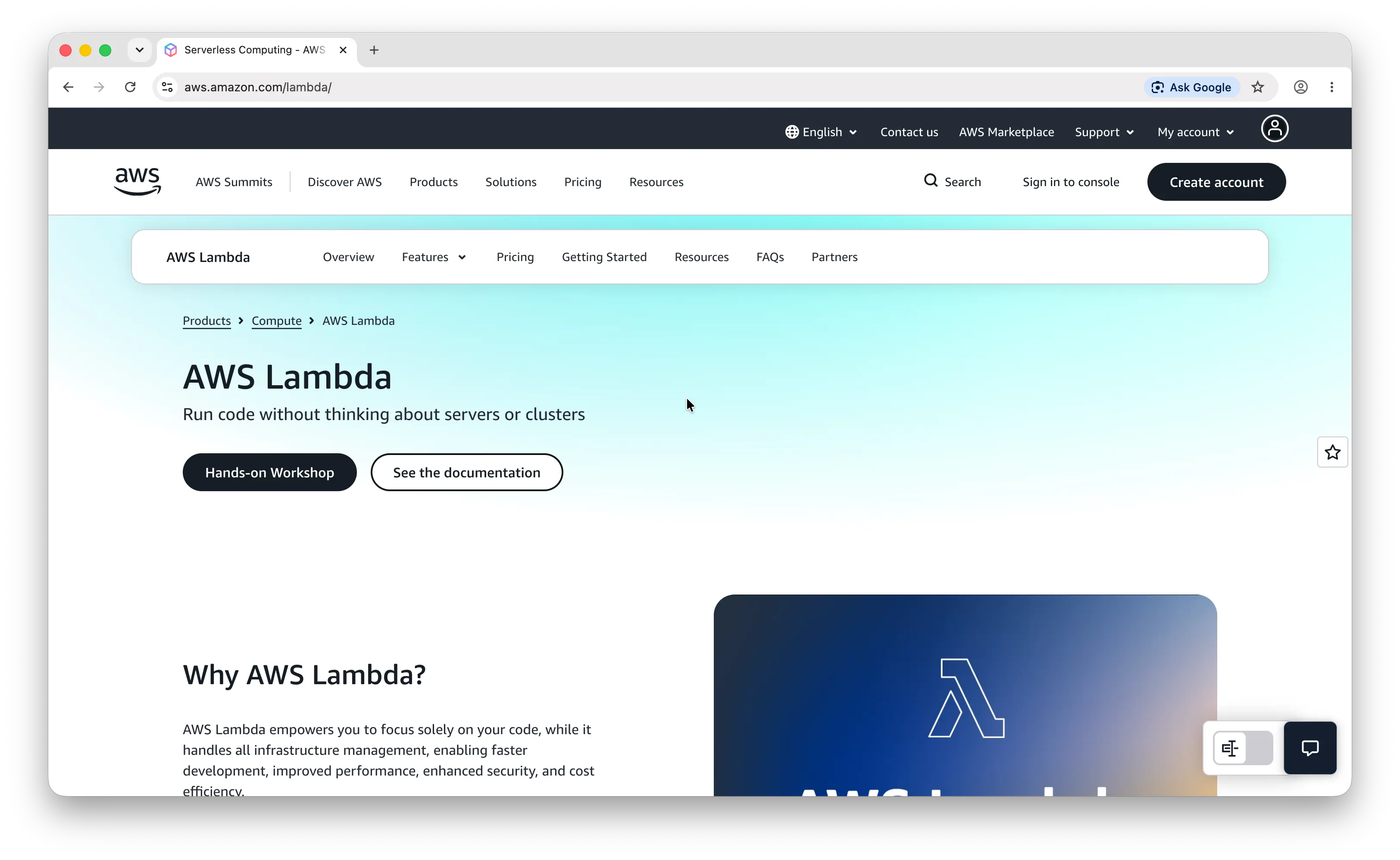
AWS Lambda is the platform that popularized serverless. It runs your code in containers or microVMs inside specific AWS regions, scales from zero to thousands of concurrent invocations automatically, and connects to 200+ AWS services as event sources.
What Makes It Different
The two big advantages over Workers are compute headroom and language breadth. Lambda goes up to 10GB of memory and 15 minutes of wall-clock execution per invocation, with up to 6 vCPUs — comfortably enough for image processing, PDF generation, ML inference, and data transforms that hit Workers' 128MB / 5-minute CPU ceiling within a single request. Lambda natively supports Node.js, Python, Java, Go, Ruby, and .NET, plus custom runtimes via container images. Workers is JavaScript, TypeScript, and WASM only; if your team writes Python or Go, Workers isn't even on the table.
Lambda is also the gravitational center of an enormous event-driven ecosystem. S3 object events, DynamoDB Streams, SQS, SNS, EventBridge, Kinesis, Step Functions, IoT, API Gateway, CloudFront — roughly 200 AWS services can trigger Lambda, and the integration patterns are deeply documented. If your data already lives in AWS, Lambda is the glue. Workers' ecosystem is smaller but architecturally cohesive (KV, R2, D1, Durable Objects, Queues all sit on the same network with no egress cost between them), so the trade-off is "depth of integrations" vs. "tightness of integration."
Key Differences from Cloudflare Workers
Lambda has real cold starts: 100–500ms typical, multiple seconds for Java without SnapStart. It runs in ~33 regions versus Workers' 330+ edge locations, so a user in Sydney hitting a us-east-1 Lambda will see 200–300ms of network latency that Workers would resolve at the local POP. And Lambda bills for wall-clock duration including I/O wait — a function that waits 200ms on a database call but burns 5ms of CPU is billed for the full 200ms, where Workers bills only the 5ms. For I/O-heavy HTTP endpoints, Workers can be 50–80% cheaper at scale (one analytics company reported ~7× savings versus Lambda + API Gateway).
Comparison Table
| Feature | AWS Lambda | Cloudflare Workers |
|---|---|---|
| Architecture | Container / microVM in regions | V8 isolate at edge |
| Cold start | 100–500ms (2s+ for Java) | <5ms |
| Billing model | Wall-clock GB-seconds | CPU time only |
| Max memory | Up to 10GB | 128MB |
| Max execution | 15 minutes | 5 minutes CPU time |
| Geographic footprint | ~33 regions | 330+ edge locations |
| Runtime support | Node, Python, Java, Go, Ruby, .NET, custom | JS, TS, WASM |
| Event-source breadth | 200+ AWS services | HTTP, Queues, Cron, Email |
| Native HTTP routing | (needs API Gateway, billed separately) |
Built-in |
| Egress fees | ~$0.09/GB to internet | $0 across Cloudflare services |
| Best for | Heavy compute, polyglot teams, AWS-native workloads | Global low-latency I/O-bound APIs |
3. Netlify Functions
Netlify Functions is, technically, AWS Lambda under the hood — Netlify wraps Lambda in a developer experience aimed at JAMstack and frontend teams. (Netlify also has Edge Functions, which run on Deno at Netlify's CDN; the two are separate products with different runtimes.)
What Makes It Different
The deployment story is the whole point. Drop a file into netlify/functions/, push to Git, and the function is live alongside your site — with the same preview deployments, branch URLs, and rollback model as the rest of your Netlify project. No Wrangler, no IAM, no wrangler.toml, no separate dashboard for compute. For a frontend team that needs a few backend endpoints, this is genuinely lower-friction than Cloudflare Workers' CLI-first workflow.
Netlify also has the widest framework adapter coverage of any deployment platform: Astro, Next.js, SvelteKit, Nuxt, Gatsby, Hugo, Eleventy. If you want forms, identity, image transformation, A/B split testing, and Blobs storage to "just work" without picking and configuring services, Netlify ships those as platform primitives. Cloudflare Pages + Workers is converging on the same shape, but Netlify's primitives are more polished out of the box.
Key Differences from Cloudflare Workers
Because Netlify Functions are Lambda, they inherit Lambda's cold starts (up to ~3 seconds in some benchmarks for cold paths), the 15-minute timeout, and the regional execution model — no edge. They also inherit Netlify's own caps on top: 20MB response size, no native WebSockets, and a much narrower trigger surface than raw Lambda. Pricing diverges sharply at scale — for ~2M visits, Cloudflare Workers sits around $5/month while Netlify Pro lands closer to $90/month, and Netlify's 2025 move to credit-based billing makes cost forecasting trickier. If raw cost and global latency are the priorities, Workers wins; if frontend-team velocity is the priority, Netlify is the smoother ride.
Comparison Table
| Feature | Netlify Functions | Cloudflare Workers |
|---|---|---|
| Underlying runtime | AWS Lambda (Edge Functions use Deno) | V8 isolate at edge |
| Cold start | Up to ~3s on Lambda-backed paths | <5ms |
| Edge presence | Netlify CDN (Edge Functions only) | 330+ edge locations |
| Deployment | Git push to Netlify | Wrangler CLI or Git (Pages) |
| Setup overhead | Near-zero for frontend teams | Wrangler + bindings to configure |
| Framework adapters | Astro, Next.js, SvelteKit, Nuxt, Gatsby, Hugo | Pages adapters (narrower) |
| Built-in frontend primitives | Forms, Identity, Blobs, Split Testing | Pages, Images, Workers KV |
| Billing model | Credit-based (from Sept 2025) | $5/mo + per-request + CPU time |
| Approximate cost at ~2M visits/mo | ~$90/mo on Pro | ~$5/mo |
| WebSocket support | |
via Durable Objects |
| Best for | JAMstack and frontend teams already on Netlify | Globally distributed APIs at scale |
4. Azure Functions
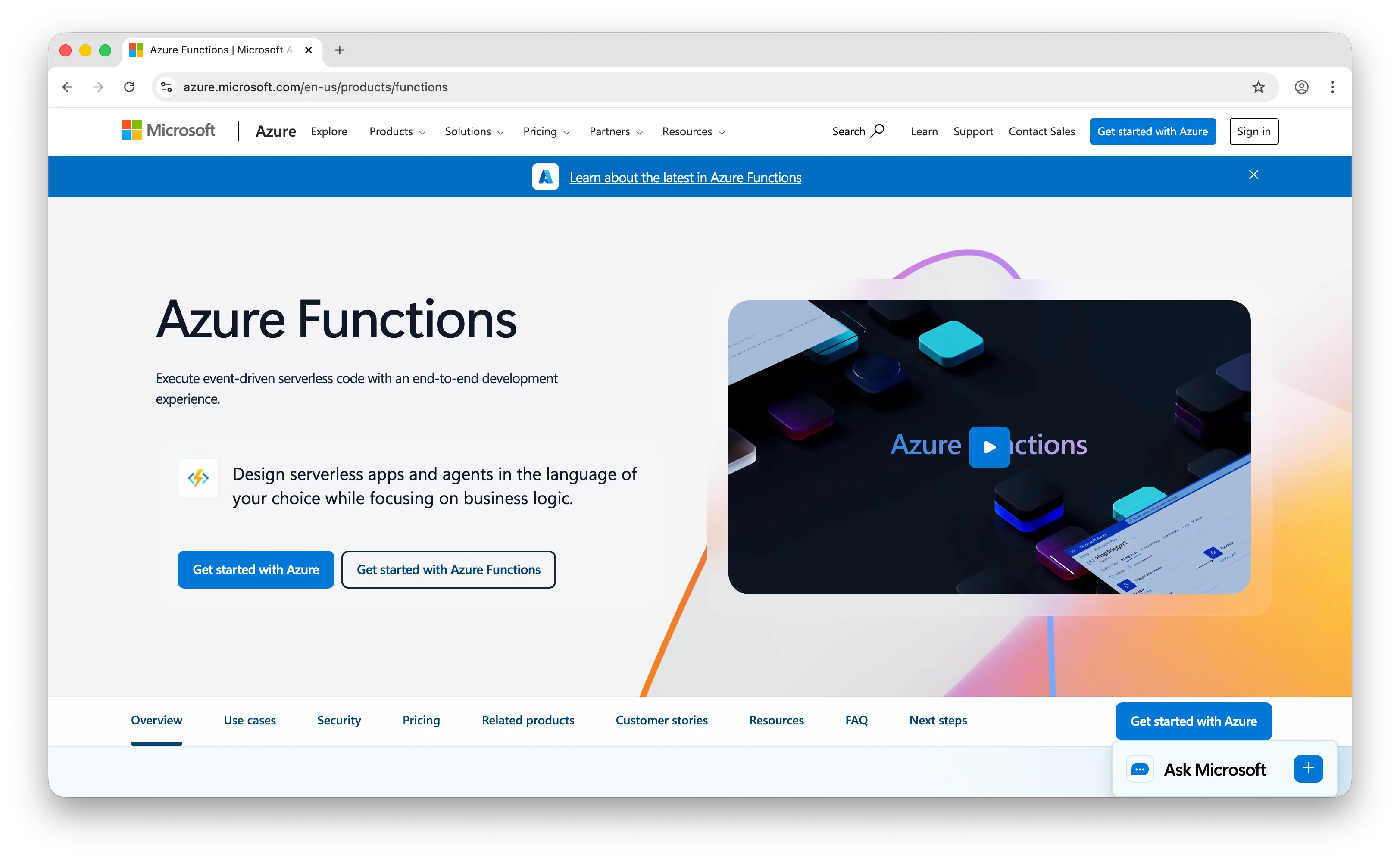
Azure Functions is Microsoft's serverless compute service — pay-per-execution, multiple language runtimes, event triggers — but a couple of design choices make it genuinely distinct from Cloudflare Workers.
What Makes It Different
The headline feature is Durable Functions, which lets you write stateful, long-running orchestrations as plain code. Fan-out/fan-in, human approval workflows, retries with backoff, and saga transactions are expressed as ordinary functions that can await other functions and survive process restarts — all in C#, JavaScript, or Python. Workers has Durable Objects (single-instance stateful actors) and the newer Workflows product, but neither expresses long-running orchestrations as imperatively as Azure does. For multi-step business processes that need to live for hours or days, Durable Functions is the cleanest model on this list.
Azure Functions also ships three hosting plans instead of Workers' single model. Premium gives you pre-warmed instances with no cold starts and unlimited execution duration; Dedicated runs on App Service for predictable cost; Consumption is the standard pay-per-use tier. The triggers-and-bindings system declaratively wires inputs and outputs from Blob Storage, Cosmos DB, Service Bus, and Event Grid — less glue code than Workers' explicit env.MY_KV.get() pattern. And for C#, F#, .NET, and PowerShell teams, the Visual Studio tooling is unmatched anywhere.
Key Differences from Cloudflare Workers
Azure Functions runs in Azure regions, not at the edge, so it has cold starts (especially on Consumption, especially for .NET) and none of Workers' global p95 latency story. Billing is in 100ms increments versus Workers' CPU-time granularity. The broader Azure surface — Active Directory, App Service, Resource Groups, ARM templates — also shows up faster than you'd expect; the platform assumes you're already in the Microsoft ecosystem, and the onboarding is heavier than spinning up a Worker. If you're not already on Azure, the operational tax is significant.
Comparison Table
| Feature | Azure Functions | Cloudflare Workers |
|---|---|---|
| Architecture | Container in Azure regions | V8 isolate at edge |
| Stateful orchestrations | Durable Functions in plain code |
Durable Objects + Workflows (different model) |
| Hosting plans | Consumption / Premium / Dedicated | Free / Paid (Standard) |
| Pre-warmed instances | Premium plan |
Not needed (no cold starts) |
| Cold start | Higher (varies by plan / runtime) | <5ms |
| Runtime support | C#, F#, Java, Python, JS, TS, PowerShell | JS, TS, WASM |
| Triggers & bindings | Declarative I/O |
Bindings (KV, R2, D1, DO) |
| Billing granularity | 100ms increments | CPU time (ms-level) |
| Microsoft ecosystem (AAD, M365, Dynamics) | Native |
|
| Hybrid / on-prem (Azure Arc) | |
|
| Edge presence | Azure regions (~30) | 330+ edge locations |
| Best for | Stateful workflows, .NET shops, Microsoft-heavy stacks | Globally distributed, low-latency APIs |
5. Google Cloud Functions
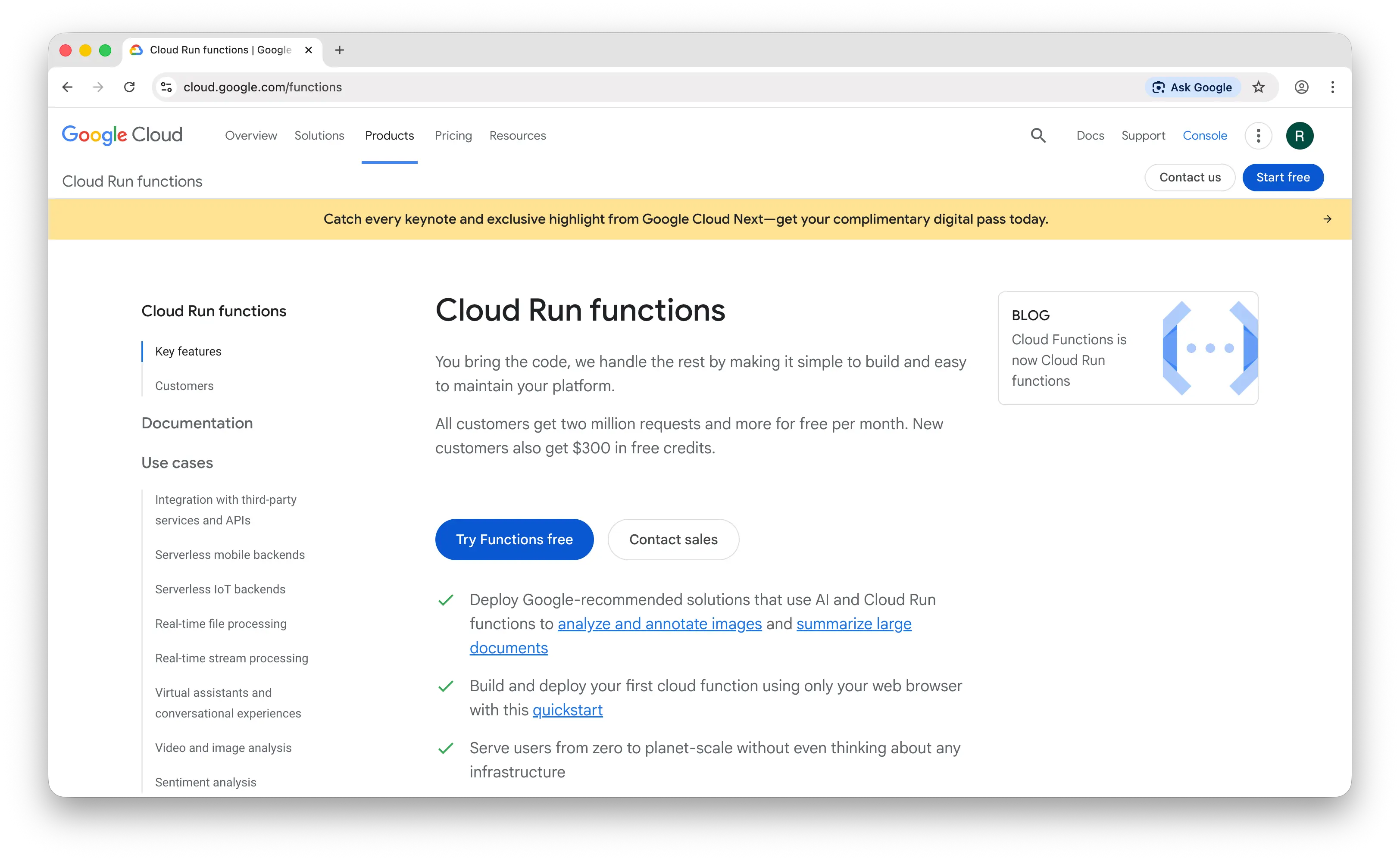
Google Cloud Functions is Google's serverless compute offering. The 2nd-generation product is built on Cloud Run, which means each function is just a container under the hood — and that single decision is what makes it interesting against Workers.
What Makes It Different
The biggest functional gap is execution headroom. 2nd-gen Cloud Functions allow up to 60 minutes per invocation and far more memory than Workers' 128MB ceiling. That makes Cloud Functions viable for nightly report generation, ETL jobs, large file transformations, and ML inference workloads that would force you off Workers entirely. Cloud Run-backed functions also have GPU support in preview (Nvidia L4), so you can run inference on open-weight models without standing up a separate inference service — something Workers cannot do at all today.
Because the runtime is a container on Cloud Run, the same image runs on any container platform without modification — your function isn't locked into a proprietary bundle the way a Worker is locked into Cloudflare's workerd. Cloud Functions supports Node, Python, Go, Java, .NET, Ruby, and PHP natively. And if you're already on Firebase, the Firestore, Auth, and Storage triggers are tighter than anything you'll wire together on Cloudflare.
Key Differences from Cloudflare Workers
Cloud Functions runs in GCP regions, not at the edge, so it has cold starts (typically 50–200ms for Node and Python, longer for Java) and none of Workers' global low-latency profile. GCP also charges ~$0.12/GB for egress where Cloudflare charges $0 across all its services — at any meaningful traffic volume, that gap shows up on the bill. Google's event-source ecosystem is also narrower than AWS's, and the long tail of community tooling, Stack Overflow answers, and third-party adapters all favor the AWS or Cloudflare side. The trade-off is "execution flexibility and language breadth" vs. "global latency and zero egress."
Comparison Table
| Feature | Google Cloud Functions | Cloudflare Workers |
|---|---|---|
| Architecture | Container (Cloud Run) in regions | V8 isolate at edge |
| Max timeout | 60 minutes (2nd gen) | 5 minutes CPU time |
| Max memory | Up to ~32GB | 128MB |
| Cold start | ~50–200ms (Node / Python) | <5ms |
| GPU support | Preview (Nvidia L4) |
|
| Container portability | Runs anywhere |
Cloudflare-specific |
| Runtime support | Node, Python, Go, Java, .NET, Ruby, PHP | JS, TS, WASM |
| Firebase integration | Native triggers |
|
| Event-source breadth | Moderate (Eventarc + GCP services) | HTTP, Queues, Cron, Email |
| Egress fees | ~$0.12/GB | $0 across services |
| Edge presence | GCP regions (~40) | 330+ edge locations |
| Best for | Long-running jobs, GPU inference, Firebase apps | Global low-latency, I/O-bound APIs |
Which Should You Choose?
Choose Puter if you're building a web app backend or AI-powered API and want the only platform here that doesn't bill you per request. The User-Pays Model makes cost passthrough to end users a built-in feature, the right-click deploy story makes Wrangler feel like overhead, and the single bundled SDK gives you AI, storage, KV, hosting, and auth without wiring up four separate Cloudflare services.
Choose AWS Lambda if you need polyglot runtimes (Python, Java, Go, .NET), heavy compute (up to 10GB memory, 15-minute runs), or the broadest event-source ecosystem in serverless. Workers can't touch memory-bound or long-running workloads, and Lambda remains the gravitational center of AWS-native architectures.
Choose Netlify Functions if your project already lives on Netlify and you'd rather have framework integration, preview deployments, and built-in forms/identity than wring out the last millisecond of latency. It costs more than Workers at scale, but for a frontend team shipping a few endpoints next to a site, the productivity trade is often worth it.
Choose Azure Functions if you need stateful orchestrations expressed as plain code (Durable Functions), or if your stack is Microsoft-heavy. Three hosting plans give you knobs Workers doesn't have, and the Visual Studio tooling is best-in-class for .NET shops.
Choose Google Cloud Functions if you need timeouts longer than Workers' 5-minute CPU cap, more than 128MB of memory, GPU-backed inference, or tight Firebase integration. The Cloud Run foundation gives you container portability that Workers' proprietary bundle doesn't offer.
Stick with Cloudflare Workers if you're building a globally distributed API where p95 latency matters, your workload is I/O-bound, and you can live within the JavaScript / TypeScript / WASM / 128MB / 5-minute envelope. For that profile, the cost and performance story is genuinely hard to beat — just be honest with yourself about whether the headline $5/mo will stay $5/mo once you've added KV, D1, R2, and Durable Objects.
Conclusion
The top 5 Cloudflare Workers alternatives are Puter, AWS Lambda, Netlify Functions, Azure Functions, and Google Cloud Functions. They sit at very different points on the abstraction spectrum — from Puter's zero-config, user-pays workers that hide the cloud entirely, to AWS Lambda's polyglot heavy-compute foundation, to Azure's stateful orchestrations, to Google's container-portable functions. The right choice depends on what you're building, who pays the bill, and how much of the infrastructure you want the platform to handle for you.
Related
Ship a Full-Stack App with One Prompt
Create a to-do list app using Puter.js
Coding manually? see the guide