Kimi K3 Review: Benchmarks, Pricing, and a Visual Coding Test
On this page
We recently added Kimi K3 to Puter.js. It's Moonshot AI's new flagship, released July 16, 2026, and at roughly 2.8 trillion parameters Moonshot positions it as the largest open-weight model announced to date. Moonshot reports coding benchmark results on par with Claude Fable 5 and GPT-5.6 Sol, models that cost about 1.7x to 3.3x more per token.
The shortest way to describe K3 is a Fable 5-level model with Sonnet 5 pricing. The independent numbers place it close behind Fable 5 and GPT-5.6 Sol rather than ahead, which still makes it the highest-ranked open-weight model to date, at exactly Sonnet 5's price. The benchmarks are widely reported already, so we spent our time on the claim that is harder to find tested, that K3 can use visual feedback for frontend work.
What Is Kimi K3?
The headline spec is size. At roughly 2.8 trillion parameters in a Mixture-of-Experts architecture, K3 is the largest open-weight model announced so far, ahead of DeepSeek V4 Pro at 1.6 trillion. Moonshot credits two new architectural components, Kimi Delta Attention and Attention Residuals, for a claimed 2.5x scaling efficiency improvement over Kimi K2.
| Spec | Kimi K3 |
|---|---|
| Parameters | ~2.8T (MoE, sparse activation) |
| Context window | 1M tokens |
| Input modalities | Text, image, video |
| Reasoning | Always-on thinking mode |
| Input price | $3.00 / 1M tokens ($0.30 cache-hit) |
| Output price | $15.00 / 1M tokens |
| Released | July 16, 2026 |
| Weights | Promised by July 27, 2026 |
| Model ID on Puter.js | moonshotai/kimi-k3 |
Two rows matter later. The model always thinks, which affects what you pay per task. And the weights were not downloadable at the time of writing, so for now the API is the only way to use it.
Benchmarks: Moonshot's Numbers and the Independent Check
Moonshot's announcement reports these results:
| Benchmark | Kimi K3 (reported by Moonshot) |
|---|---|
| SWE Marathon (long-horizon coding) | 42.0 |
| Terminal-Bench 2.1 | 88.3 |
| BrowseComp (agentic browsing) | 91.2 |
| GPQA Diamond | 93.5% |
| Arena Frontend Code Arena | 1st place |
On SWE Marathon, Moonshot's reported 42.0 is above both Fable 5 (35.0) and GPT-5.6 Sol (39.0), which would make it the first open-weight model to lead a major long-horizon coding benchmark. Moonshot's own blog is more measured than the coverage, stating that K3 is frontier-level but still trails Fable 5 and GPT-5.6 Sol overall.
The main independent check so far is Artificial Analysis, which scored K3 57 on its Intelligence Index, third place overall, behind Fable 5 and GPT-5.6 Sol and above Claude Opus 4.8. It also measured a hallucination rate of 51%, up from K2.6's 39%, so the intelligence gains came with a regression there.
Most of Moonshot's results have not yet appeared on the benchmark owners' public leaderboards, and different scores used different agent harnesses. Treat the vendor numbers as directional until third-party runs land.
We Tested the Visual Coding Claim
Moonshot says K3 can take screenshots of a design or a rendered page and use them as feedback while coding, and the Frontend Code Arena first place is the number attached to that claim. The core skill in that workflow is seeing the difference between a design and a render, so that is what we tested, with an answer key.
We screenshotted a real page as the target, edited its CSS to introduce five visual mistakes, and screenshotted the result. We sent both images to the model in one call and asked it to list every difference it could see. Since we made the changes ourselves, scoring is a count, how many of the five it caught and how many differences it reported that we never made. We tested K3 alone; the answer key makes the score meaningful without a side-by-side.
The whole test is one call:
const design = "https://rey-assets.puter.site/kimi-k3/target.webp";  // the original page
const render = "https://rey-assets.puter.site/kimi-k3/current.webp"; // same page with CSS mistakes

const response = await puter.ai.chat(
    "The first image is the target design. The second image is the current implementation. " +
    "List every visual difference you can see.",
    [design, render],
    { model: "moonshotai/kimi-k3", stream: true }
);

for await (const part of response) {
    if (part?.reasoning) puter.print(part.reasoning); // thinking streams first
    if (part?.text) puter.print(part.text);
}
You can run this yourself in the Puter playground or on any served page.
Here are the two screenshots we used. The page is our own homepage, so we control the ground truth end to end. First the target:
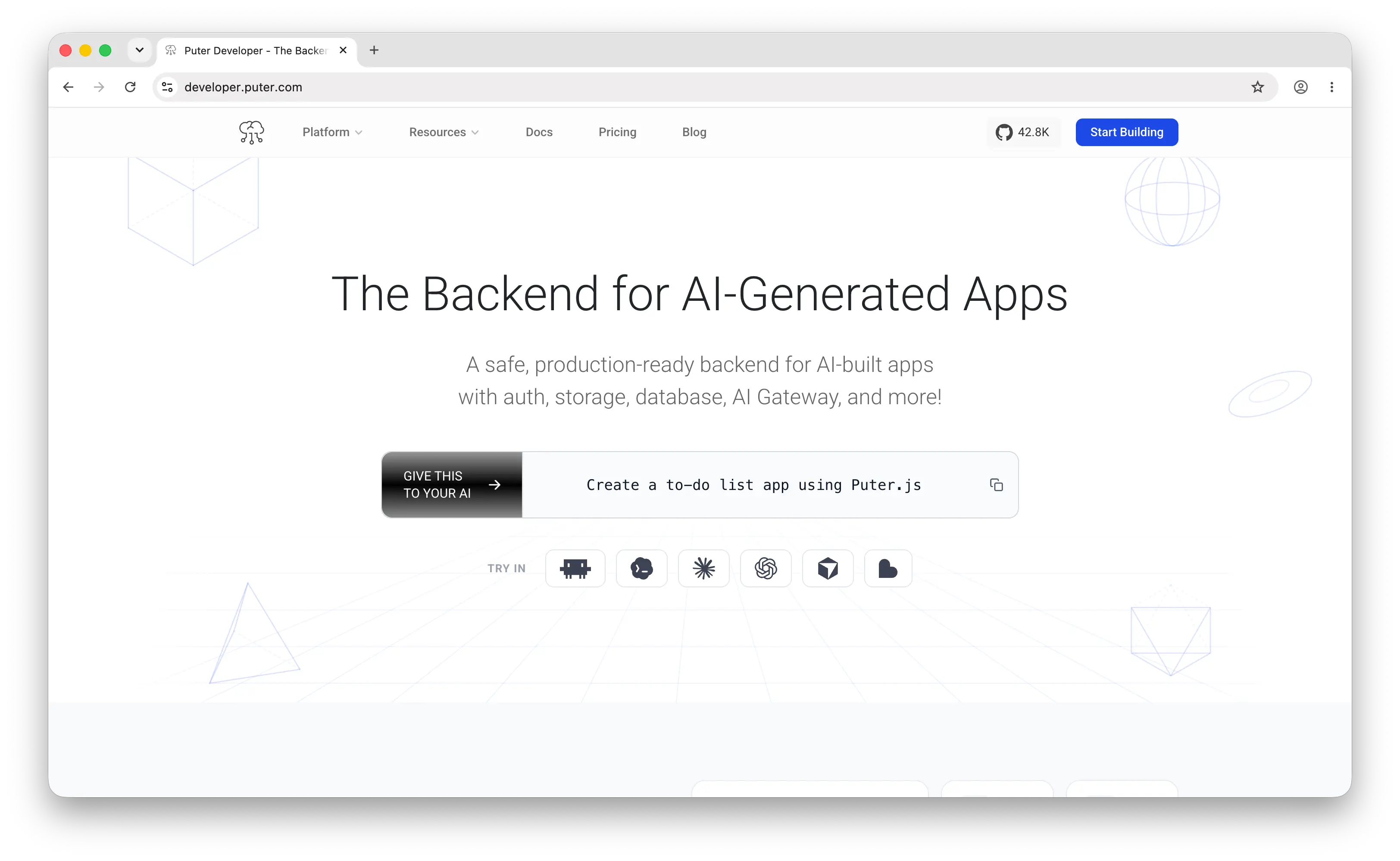
The target design
And the version with five CSS mistakes:
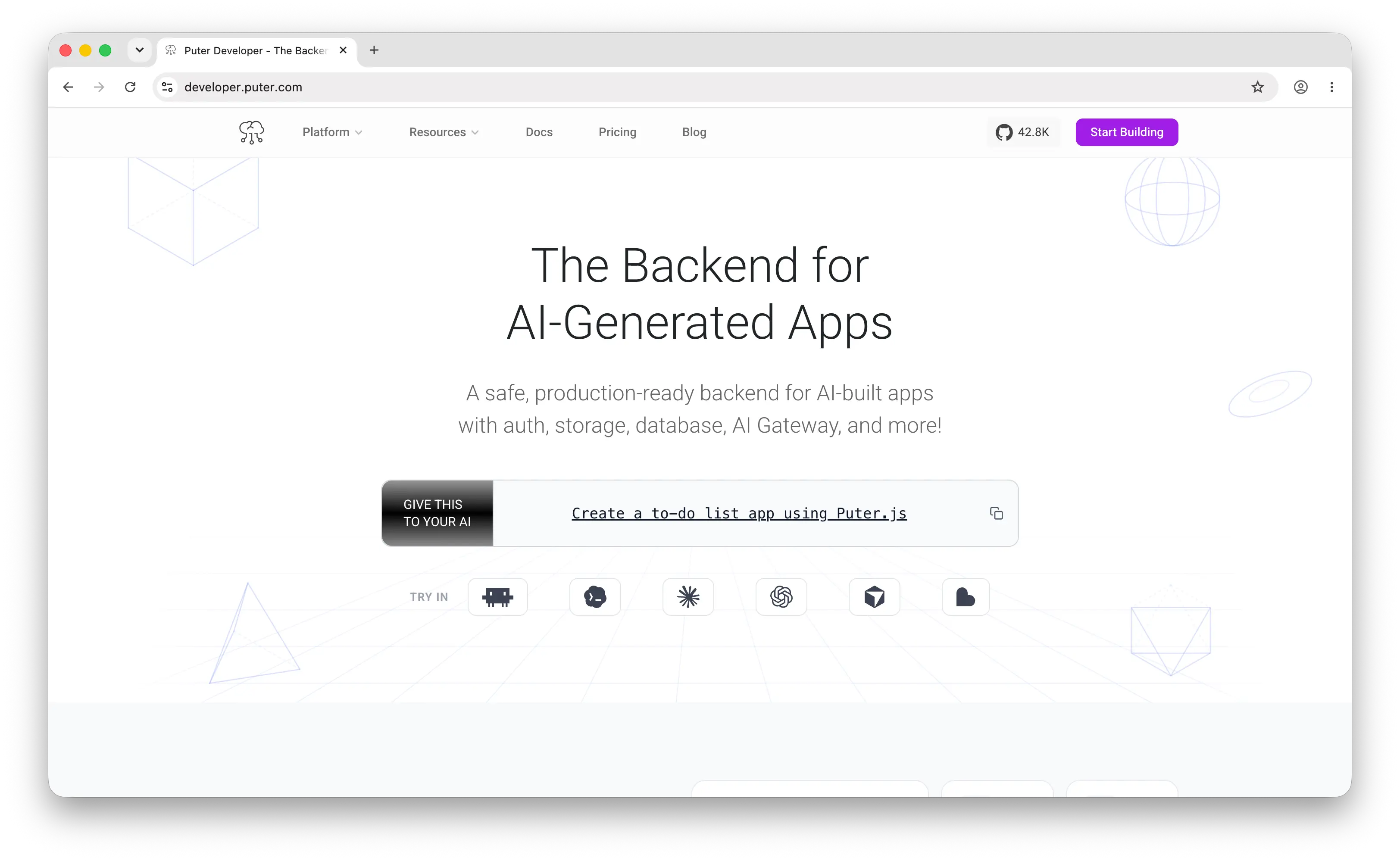
The same page with five changes introduced
What We Found
K3 caught all five changes:
| Change we made | Caught? |
|---|---|
| Headline forced to wrap to two lines | Yes, and it noted the wrap pushes the content below it down |
| "Start Building" button changed from blue to purple | Yes |
| Prompt text underlined | Yes |
| "TRY IN" icon row spacing widened | Yes, with an imprecise description |
| Right-pointing arrow removed from the "GIVE THIS TO YOUR AI" button | Yes |
The removed arrow is the result that stands out. It is a small icon inside one button, the kind of change that survives a quick visual scan, and the model flagged it along with the knock-on effect that the button got narrower without it.
It reported no differences we did not make, which we watched for given the 51% hallucination rate above. The one blemish, on the icon spacing change, it described the original row as a "segmented control" with the icons touching, when they are separate boxes with small gaps. It saw the change correctly but misdescribed the layout.
This is one run on one page, a spot check rather than a benchmark. Within that limit, the result supports Moonshot's claim.
What Kimi K3 Actually Costs
Here is K3 next to its predecessor and the two Anthropic models it gets compared against:
| Model | Input / 1M tokens | Output / 1M tokens |
|---|---|---|
| Kimi K2.6 | $0.95 | $4.00 |
| Kimi K3 | $3.00 | $15.00 |
| Claude Sonnet 5 | $3.00 | $15.00 |
| Claude Fable 5 | $10.00 | $50.00 |
Two facts stand out. K3 costs about 3x what K2.6 did on input and nearly 4x on output, so the pattern of Chinese open-weight models undercutting everything on price does not apply here. And its price matches Claude Sonnet 5 exactly, so the practical question is not whether K3 is cheap but whether it outperforms the model at its own price point.
Cache-hit input drops to $0.30 per million tokens, a 90% discount. A task with 100K input tokens and 20K output tokens costs about $0.60 fresh, or about $0.33 fully cached, so agent loops that resend the same context benefit the most.
The sticker price also understates output costs, since K3 always thinks and runs verbose. Artificial Analysis measured $0.94 per task, close to GPT-5.6 Sol ($1.04) and about half of Opus 4.8 ($1.80).
On Puter's User-Pays model, each user covers their own usage, so these per-token prices land on your users rather than on you as the developer.
Limitations
- The weights were not downloadable at the time of writing. Moonshot promises them by July 27, 2026, so until then "open-weight" is a plan rather than a fact.
- Most of Moonshot's benchmark results have not been independently reproduced, and the ones that exist (Artificial Analysis) place K3 behind Fable 5 and GPT-5.6 Sol rather than ahead.
- Capacity is constrained at launch. OpenRouter currently warns that the model may return frequent 429 errors.
- There is no non-thinking mode, so you cannot trade reasoning depth for cost on simple tasks the way you can with models that expose an effort control.
- Artificial Analysis measured a 51% hallucination rate, up from 39% for K2.6.
- Moonshot hosts inference outside the US and EU, which matters if you handle regulated data.
Who Should Use Kimi K3
- Long-horizon coding agents and repository-scale tasks are the strongest fit, this is what the model was built for and where its reported results are best.
- Frontend work with visual feedback is worth trialing, the model takes screenshots natively and our test results above show where it stands today.
- High-volume, simple tasks are a poor fit at $15 per million output tokens with always-on thinking. K2.6 remains available at about a quarter of the price.
- Teams with strict data residency requirements should wait for the weights and self-host.
Try It in Puter.js
Kimi K3 is available on Puter.js now, with no API keys and no server setup. From a script tag:
<html>
<body>
    <script src="https://js.puter.com/v2/"></script>
    <script>
        puter.ai.chat(
            "Build a pricing page with three tiers as a single HTML file.",
            { model: "moonshotai/kimi-k3" }
        ).then(response => puter.print(response));
    </script>
</body>
</html>
Or from npm with @heyputer/puter.js:
// npm install @heyputer/puter.js
import { puter } from "@heyputer/puter.js";

const response = await puter.ai.chat(
    "Build a pricing page with three tiers as a single HTML file.",
    { model: "moonshotai/kimi-k3" }
);
Both expose the same puter.* API.
FAQ
Is Kimi K3 free to use?
Moonshot's API charges $3 per million input tokens and $15 per million output tokens. Through Puter.js there are no API keys and no developer-side bill, usage is covered by each user under the User-Pays model.
Is Kimi K3 open source?
It is announced as open-weight, but the weights were not yet downloadable at the time of writing. Moonshot says they will be released by July 27, 2026.
Is Kimi K3 better than Claude Fable 5?
Moonshot reports K3 ahead on some coding benchmarks, including SWE Marathon (42.0 vs 35.0). The independent Artificial Analysis Intelligence Index places K3 third, behind Fable 5 and GPT-5.6 Sol. On current evidence it is a Fable 5-level model at Sonnet 5 pricing, the closest an open-weight model has come to the frontier without passing it.
How big is Kimi K3's context window?
1 million tokens, with support for text, image, and video input.
Can Kimi K3 see images?
Yes. It accepts image and video input natively, which is what makes screenshot-driven frontend workflows possible.
How much does Kimi K3 cost compared to Kimi K2.6?
About 3x more on input ($3.00 vs $0.95 per million tokens) and nearly 4x more on output ($15.00 vs $4.00).
Related
Ship a Full-Stack App with One Prompt
Create a to-do list app using Puter.js
Coding manually? see the guide