Best Deepgram Alternatives (2026)
On this page
Deepgram built its reputation on fast, accurate speech-to-text (Nova-3, Flux) and has since expanded into text-to-speech with Aura-2 and a unified Voice Agent API. For real-time call centers that need sub-200ms latency, regulated industries that require on-premise deployment, and teams that want STT and TTS from one vendor, it's a strong default.
But "strong default" and "right for your project" aren't the same thing. If you care more about expressive voices, bulk TTS cost, multilingual coverage, open-source control, or just not running a backend, there are five alternatives worth weighing before you commit to Deepgram.
1. Puter.js
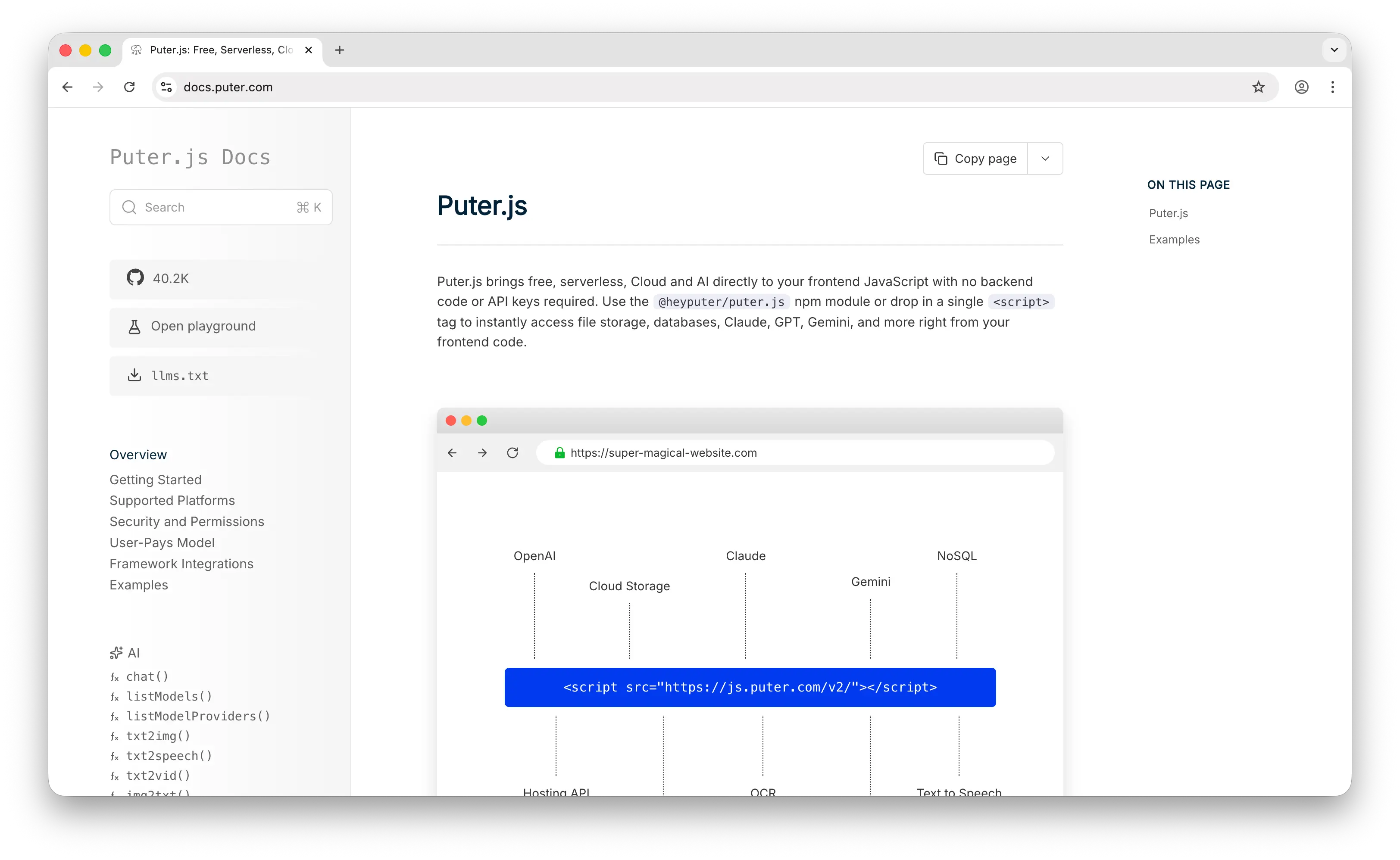
Puter.js is a drop-in JavaScript library that gives frontend code an entire backend: AI, database, cloud storage, and auth. On the voice side specifically, it wraps AWS Polly, OpenAI TTS, and ElevenLabs behind a single puter.ai.txt2speech() call, and routes Whisper, GPT-4o Transcribe, and a diarization model through puter.ai.speech2txt().
What Makes It Different
The core shift from Deepgram is economic. Deepgram bills you, the developer, for every minute transcribed and every character synthesized. Puter.js uses the User-Pays Model: your users cover their own voice AI usage through their Puter account. That means TTS and transcription can ship without an API key, without a backend proxy, and without a meter that grows with your DAU — which matters a lot when voice is one of the most expensive AI primitives to expose to users.
The second shift is provider access. Deepgram gives you Deepgram, one STT model, one TTS model, one voice agent stack. Puter.js is vendor-agnostic: you can A/B Polly's Generative voices against OpenAI tts-1-hd against ElevenLabs Flash without rewriting your integration, and pick the right engine per job (cheap bulk reads from Polly, expressive narration from ElevenLabs, steerable prompts from gpt-4o-mini-tts). Voice cloning and voice conversion via puter.ai.speech2speech() are included through the same API.
Key Differences from Deepgram
Puter.js is primarily designed for web apps running on the frontend. While it works in Node.js, the user-pays model is most natural in a browser context. It does not offer its own proprietary STT or TTS model, no equivalent to Nova-3 or Aura-2, and it does not have an on-premise deployment option for regulated industries. It also lacks the enterprise observability, SLAs, and deep voice-agent orchestration tools that Deepgram ships for large call-center deployments.
Comparison Table
| Feature | Puter.js | Deepgram |
|---|---|---|
| API key required | No | Yes |
| Pricing model | User-pays (free for devs) | Pay-as-you-go (~$0.0077/min STT, $30/M chars TTS) |
| Markup | At cost | Proprietary |
| Speech-to-text |  (Whisper, GPT-4o Transcribe) (Whisper, GPT-4o Transcribe) |
(Nova-3, Flux) |
| Text-to-speech | (Polly, OpenAI, ElevenLabs) |
(Aura-2) |
| Voice cloning | (via ElevenLabs) |
 |
| Speaker diarization | |
(add-on) |
| Voice Agent API | |
|
| On-prem deployment | |
|
| Multi-provider access | |
|
| Backend required | No | Yes |
| Client-side SDK | |
Limited |
| Language coverage | Extensive (via aggregated providers) | ~7 languages for TTS |
| Observability | Limited | Enterprise dashboard |
| Best for | Frontend/web app devs who want zero-cost voice AI | Enterprise teams needing unified voice-agent infra |
2. ElevenLabs
ElevenLabs is a voice AI platform known for producing some of the most natural-sounding synthetic voices on the market. Like Deepgram, it now covers the full voice stack, text-to-speech, speech-to-text (Scribe), and conversational voice agents, but its reputation and primary strength are in TTS quality and voice cloning.
What Makes It Different
ElevenLabs has a library of 3,000+ voices and offers both instant voice cloning (from short samples) and professional voice cloning (from longer, curated recordings) with emotional nuance that Deepgram's Aura-2 doesn't match. Its Flash v2.5 model hits around 75ms time-to-first-byte, faster than Deepgram Aura-2's ~90ms, which makes it highly competitive for real-time voice agents.
ElevenLabs also supports 70+ languages on its Multilingual v2 and v3 models, versus roughly 7 for Deepgram's TTS. For creators producing audiobooks, dubbing, or expressive long-form narration, ElevenLabs is usually the default pick.
Key Differences from Deepgram
ElevenLabs' credit-based pricing can get expensive fast, and it runs separate UI subscription and API subscription tiers, which makes forecasting cost harder than with Deepgram's simple per-minute/per-character model. Commercial rights don't kick in until paid tiers, a gotcha for indie developers. On pure STT accuracy and enterprise deployment (on-prem, call-center scale, HIPAA-adjacent workflows), Deepgram is still the more battle-tested choice. ElevenLabs also does not offer on-premise deployment.
Comparison Table
| Feature | ElevenLabs | Deepgram |
|---|---|---|
| Pricing model | Credit-based subscriptions ($0–$1,320/mo) + API tiers | Pay-as-you-go + Growth plan |
| Free tier | 10,000 credits/month | $200 free credit |
| Speech-to-text | (Scribe) |
(Nova-3) |
| Text-to-speech | (Flash, Multilingual v2/v3) |
(Aura-2) |
| Voice cloning | (instant + professional) |
|
| Voice library size | 3,000+ voices | ~40 voices |
| TTS latency (lowest) | ~75ms (Flash v2.5) | ~90ms (Aura-2) |
| Voice Agent API | (Conversational AI) |
|
| Language coverage (TTS) | 70+ | ~7 |
| On-prem deployment | |
|
| Commercial rights on free tier | |
|
| Best for | Expressive TTS, voice cloning, creators, dubbing | Real-time STT, enterprise voice agents, regulated deployments |
3. OpenAI TTS
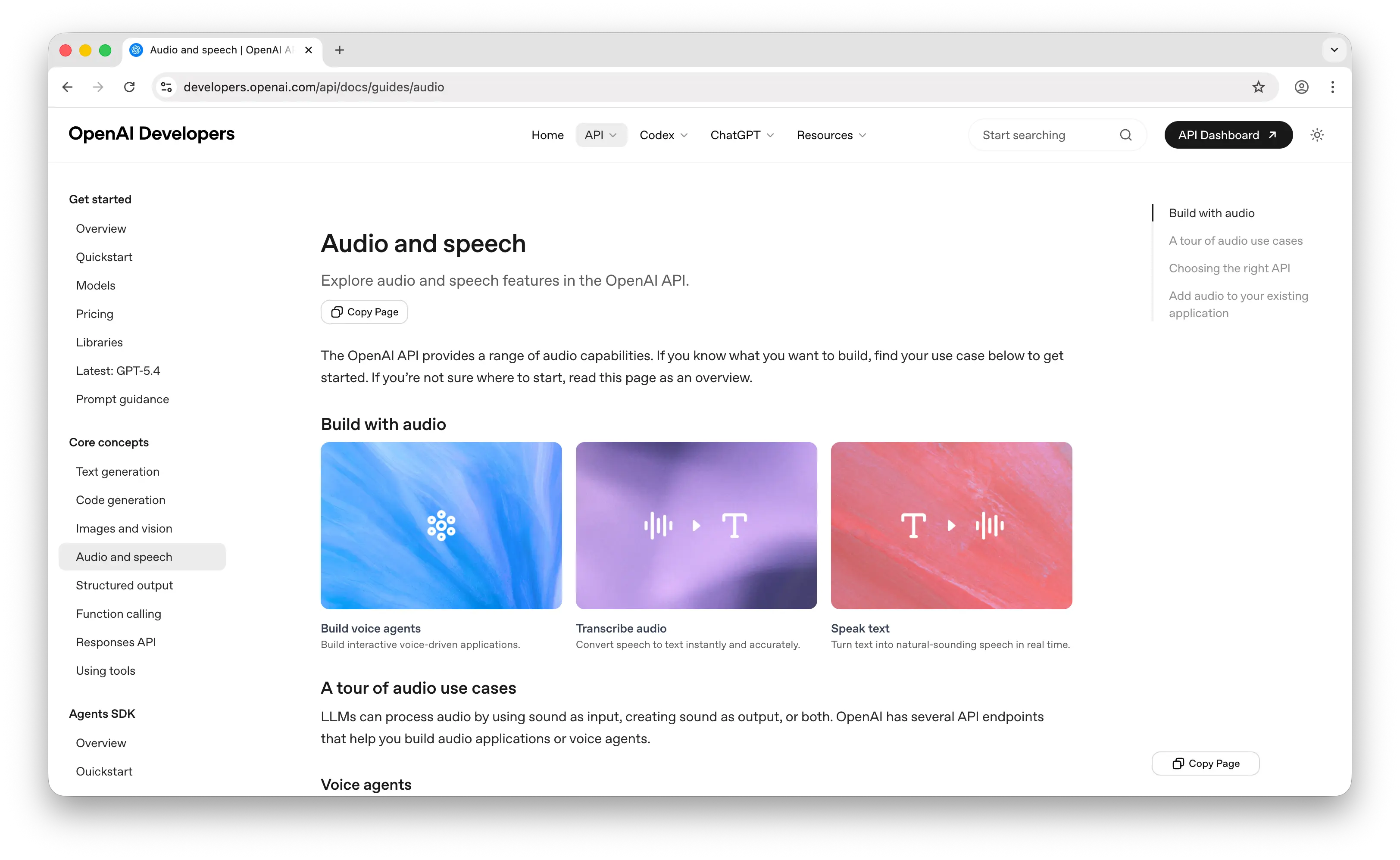
OpenAI TTS is OpenAI's text-to-speech API, available through the /audio/speech endpoint. It includes three model tiers: tts-1 (standard), tts-1-hd (high-definition), and gpt-4o-mini-tts (the newest, multimodal, instruction-steerable model).
What Makes It Different
The standout feature is instruction steerability in gpt-4o-mini-tts. Instead of only picking a voice, you can prompt how the voice should sound, for example "speak in a cheerful whisper" or "sound like a sports commentator". This isn't something Deepgram Aura-2 or Amazon Polly currently offer.
OpenAI TTS is also cheap: tts-1 is $15 per million characters, tts-1-hd is $30 per million, and gpt-4o-mini-tts works out to roughly $0.015 per minute of audio. It ships 11–13 built-in voices (Alloy, Nova, Onyx, Shimmer, Echo, Fable, and more), and supports MP3, Opus, AAC, FLAC, WAV, and PCM output formats. If you're already using the OpenAI platform for LLMs, adding TTS is a one-line change.
Key Differences from Deepgram
OpenAI TTS is text-to-speech only. Speech-to-text (Whisper, GPT-4o Transcribe) lives on separate endpoints, and there's no unified "voice agent" orchestration layer like Deepgram's Voice Agent API. Latency is around 0.5 seconds, noticeably slower than Deepgram's sub-200ms target, which matters for real-time conversational agents. OpenAI TTS also has no on-premise option, no voice cloning, and no telephony-focused features like barge-in detection.
Comparison Table
| Feature | OpenAI TTS | Deepgram |
|---|---|---|
| Pricing model | Per character / per token | Pay-as-you-go per character |
| TTS standard price | $15 / 1M chars | $30 / 1M chars (Aura-2) |
| TTS HD price | $30 / 1M chars | Single rate |
| Free tier | $5 credit (new accounts) | $200 credit |
| Speech-to-text | Separate (Whisper / GPT-4o Transcribe) | (unified) |
| Text-to-speech | |
|
| Voice cloning | |
|
| Instruction-steerable voices | (gpt-4o-mini-tts) |
|
| Voice Agent API | |
|
| TTS latency | ~0.5s | ~90–200ms |
| Voices | 11–13 built-in | ~40 |
| On-prem deployment | |
|
| Max input per request | 4,096 characters | Higher |
| Best for | Cheap TTS with prompt-level voice control | Real-time voice agents and enterprise STT |
4. Amazon Polly
Amazon Polly is AWS's managed text-to-speech service, one of the most mature TTS offerings on the market. It offers four engine tiers, Standard, Neural, Long-Form, and Generative, and integrates deeply with the rest of the AWS ecosystem.
What Makes It Different
Polly has the widest pricing range on this list: $4 per million characters for Standard voices, $16/M for Neural, $30/M for Generative, and $100/M for Long-Form. That makes it the cheapest option by far for high-volume, non-premium workloads. Its Generative engine is a billion-parameter transformer with 43 voices that now supports bidirectional streaming (launched in AWS regions through early 2026), closing the latency gap with Deepgram for real-time use cases.
Polly is also HIPAA-eligible, has full SSML support, custom lexicons, and Speech Marks for lip-sync and karaoke-style highlighting. If your infrastructure is already on AWS, IAM, VPC, CloudWatch, it's the path of least resistance.
Key Differences from Deepgram
Polly is text-to-speech only. AWS's speech-to-text product is a separate service (Amazon Transcribe), so you lose Deepgram's unified-platform advantage, the Voice Agent API and tight STT+TTS integration have no direct equivalent. Polly also carries AWS's usual complexity overhead: IAM roles, SDK setup, regional endpoint configuration. Deepgram is dramatically faster to get started with for a solo developer. And while Polly Generative is good, Deepgram Aura-2 is still purpose-built for call-center voice agents with pronunciation tuning for drug names, alphanumeric IDs, and legal references.
Comparison Table
| Feature | Amazon Polly | Deepgram |
|---|---|---|
| Pricing model | Per character (4 engine tiers) | Per character (Aura-2) / per minute (STT) |
| Standard TTS price | $4 / 1M chars | N/A (single tier) |
| Neural TTS price | $16 / 1M chars | N/A |
| Generative TTS price | $30 / 1M chars | $30 / 1M chars |
| Free tier | 5M chars Standard / 1M Neural (12 months) + $200 AWS credit | $200 credit |
| Speech-to-text | Separate (Amazon Transcribe) | (unified) |
| Text-to-speech | |
|
| Voice Agent API | |
|
| Voice cloning | Brand Voice (custom engagement) | |
| Bidirectional streaming | (Generative) |
|
| SSML support | (full) |
Partial |
| HIPAA eligible | |
(with BAA) |
| On-prem deployment | |
|
| Ecosystem integration | AWS (IAM, S3, Lambda, etc.) | Standalone API |
| Best for | Teams already on AWS, bulk TTS, regulated industries | Real-time voice agents and unified STT + TTS |
5. Chatterbox
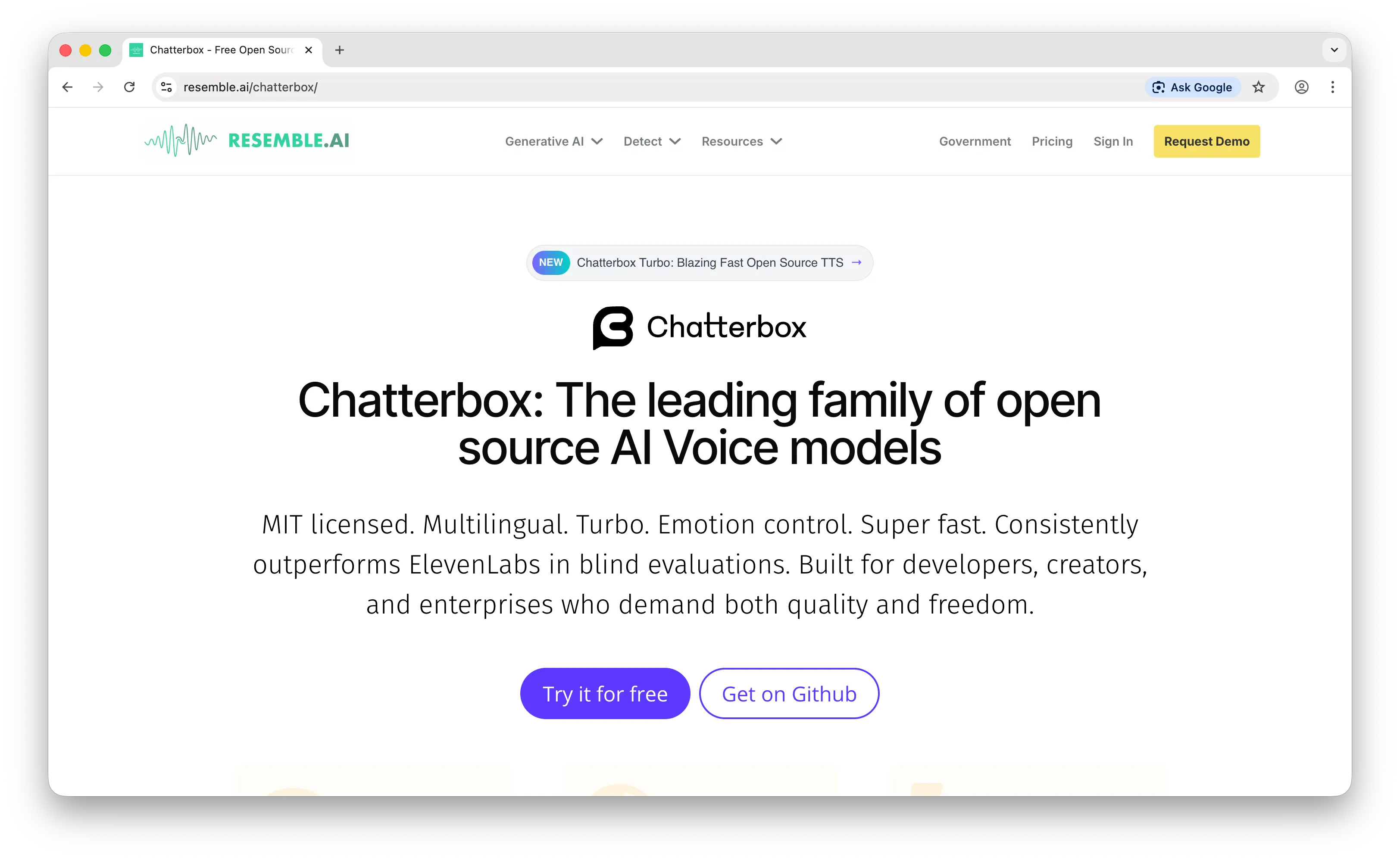
Chatterbox is a family of MIT-licensed, open-source text-to-speech models from Resemble AI. It ships in three variants: original Chatterbox (English, expressive), Chatterbox Multilingual (23 languages), and Chatterbox Turbo (a streamlined 350M-parameter model built for low-latency voice agents).
What Makes It Different
Chatterbox is fully open-source and self-hostable, which is a categorical break from every managed API on this list. It offers zero-shot voice cloning from a ~10-second reference clip, an industry-first emotion exaggeration parameter (tune voices from monotone to dramatically expressive with one slider), and paralinguistic tags like [laugh], [cough], and [chuckle] native to the Turbo model.
Every output is signed with Resemble's PerTh neural watermark, an imperceptible audio watermark designed to survive MP3 compression and editing, so you can detect AI-generated audio downstream. In Podonos blind evaluations, around 63% of listeners preferred Chatterbox over ElevenLabs. It has crossed 1 million downloads on Hugging Face and 11,000+ GitHub stars.
Key Differences from Deepgram
Chatterbox is TTS only, no speech-to-text, no voice agent API. It's also not a managed service by default: you're running it on your own GPUs, which means you trade per-character fees for infrastructure and ops work. There's no SLA, no support contract, and no turnkey call-center features unless you upgrade to Resemble's paid Chatterbox Multilingual Pro offering, which adds sub-200ms streaming, custom fine-tuning, and uptime guarantees. If you need production-grade support on day one, Deepgram is the safer call.
Comparison Table
| Feature | Chatterbox | Deepgram |
|---|---|---|
| Pricing model | Free (self-hosted) or Resemble Pro tier | Pay-as-you-go |
| License | MIT (open source) | Proprietary |
| Self-hosting | |
(Enterprise) |
| Speech-to-text | |
|
| Text-to-speech | |
|
| Voice cloning | (zero-shot, ~10s clip) |
|
| Emotion control | (exaggeration parameter) |
|
| Paralinguistic tags | (Turbo) |
|
| Watermarking | (PerTh, built-in) |
|
| Language coverage | 23 (Multilingual) | ~7 (TTS) |
| Voice Agent API | |
|
| SLA / support | Only on Pro tier | |
| Infrastructure required | Yes (GPU) | No |
| Best for | Teams wanting full control, open-source voice cloning, emotion-rich TTS | Managed real-time voice agents and enterprise STT |
Which Should You Choose?
Choose Puter.js if you're building a web app and want to add speech-to-text and text-to-speech without a backend, API keys, or per-user billing. The user-pays model is ideal for developers who don't want to worry about covering voice AI costs as their user base grows, and the multi-provider aggregation means you're not locked into a single vendor's voices.
Choose ElevenLabs if TTS quality and voice cloning are your top priorities. It has the deepest voice library, the best expressive long-form narration, and the lowest published TTS latency on the market. Just be ready for credit-based pricing that can climb fast at scale.
Choose OpenAI TTS if you want cheap, good-enough TTS with prompt-level voice control and you're already building on the OpenAI platform. gpt-4o-mini-tts's instruction steerability is genuinely unique.
Choose Amazon Polly if you're already on AWS, need HIPAA eligibility, or are generating bulk TTS where cost per character matters more than cutting-edge voice quality. The Standard engine at $4/M characters is unbeatable for high-volume workloads.
Choose Chatterbox if you want full control, no per-character fees, or you're building a product where voice cloning, emotion control, and audio watermarking are differentiators. Just budget for the GPUs and ops work.
Stick with Deepgram if you need enterprise-grade real-time voice agents with unified STT + TTS, sub-200ms latency, on-premise deployment for regulated industries, or best-in-class transcription accuracy for call centers and healthcare. It's still the strongest single-vendor choice when voice is mission-critical.
Conclusion
The top 5 Deepgram alternatives are Puter.js, ElevenLabs, OpenAI TTS, Amazon Polly, and Chatterbox. Each takes a different approach to voice AI, from Puter.js's zero-cost frontend integration to ElevenLabs' premium cloned voices, from Amazon Polly's AWS-native scale to Chatterbox's fully open-source stack. Whichever platform you choose, the best option is the one that fits your stack, your budget, and how your users will interact with voice in your app.
Related
- Getting Started with Puter.js
- Free, Unlimited Speech-to-Text API
- Free, Unlimited Text-to-Speech API
- Free, Unlimited OpenAI Text to Speech API
- Free, Unlimited ElevenLabs API
- Free, Unlimited Voice Changer API
- Best Text to Speech APIs in 2026
- Best ElevenLabs Alternatives (2026)
- Best AssemblyAI Alternatives (2026)
- Best fal.ai Alternatives (2026)
- Top 5 OpenRouter Alternatives (2026)
- Top 5 Replicate Alternatives (2026)
- Best Together AI Alternatives (2026)
- Top 5 Google AI Studio Alternatives (2026)
- Top 5 Vertex AI Alternatives (2026)
- Best AWS Bedrock Alternatives (2026)
Ship a Full-Stack App with One Prompt
Create a to-do list app using Puter.js
Coding manually? see the guide