Best AssemblyAI Alternatives (2026)
On this page
AssemblyAI has become one of the leading speech-to-text platforms for developers—and for good reason. Its Universal models support 99 languages, its speech understanding stack covers speaker diarization, sentiment analysis, entity detection, summarization, and PII redaction, and its LeMUR feature lets you run LLM-powered analysis directly on transcripts. But AssemblyAI's à la carte feature pricing, server-side-only API, and reliance on a single proprietary model family aren't the right fit for every project.
Here are five alternatives worth considering, each with a different take on speech-to-text.
1. Puter.js
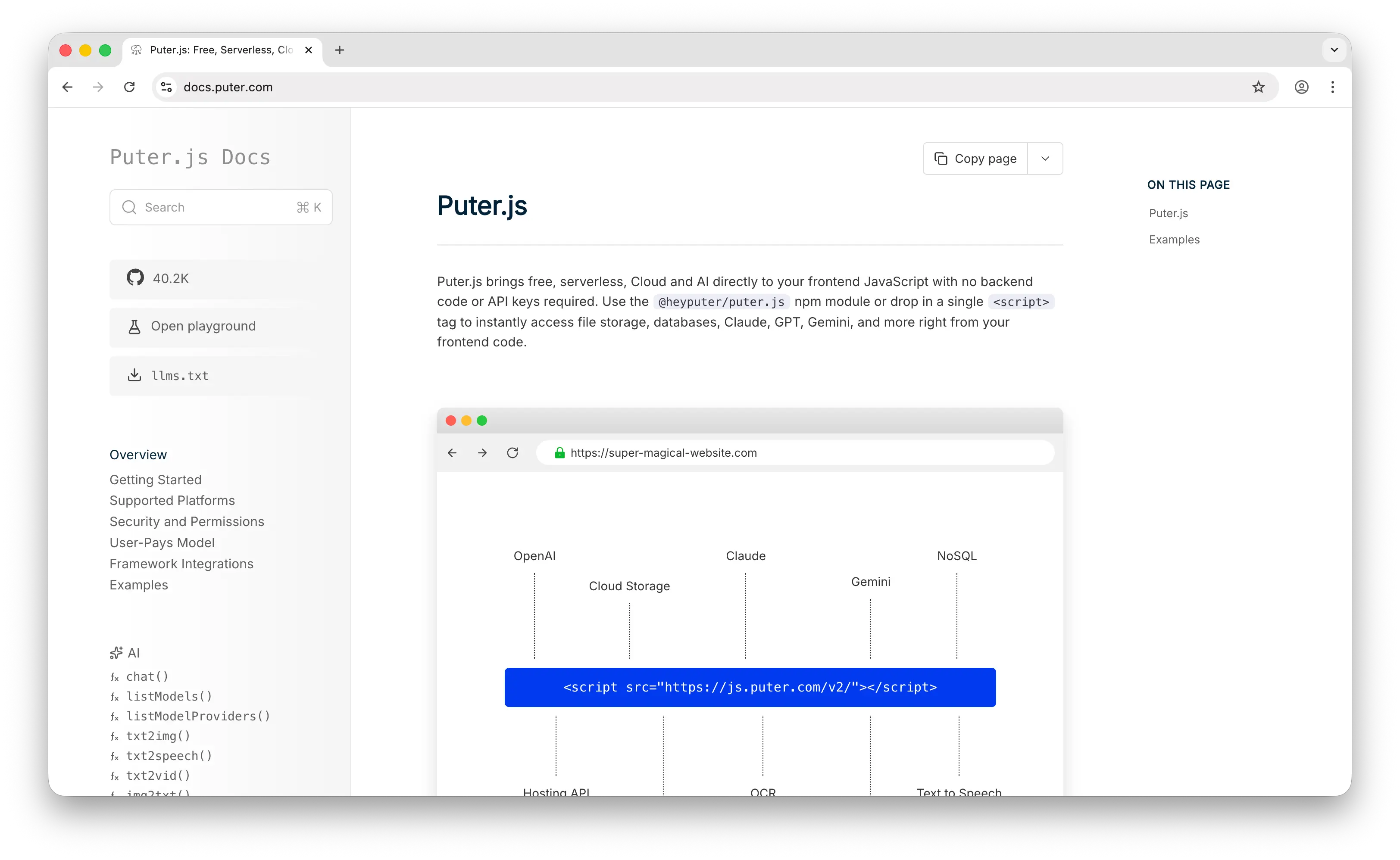
Puter.js is a JavaScript library for building web apps with built-in cloud services—AI, storage, databases, and authentication. For speech-to-text specifically, it acts as a unified frontend for multiple STT providers, letting you call OpenAI Whisper, GPT-4o Transcribe, and xAI Grok STT through the same puter.ai.speech2txt() API without managing separate API keys for each.
What Makes It Different
The cost model is the headline: Puter.js uses a User-Pays Model where each end user covers their own transcription costs through their Puter account. As a developer, you pay nothing—no subscription, no per-minute billing, no API key management. You can ship a transcription-enabled app to thousands of users without a single dollar in STT expenses on your end. With AssemblyAI, every minute your users transcribe comes out of your prepaid credits or pay-as-you-go bill.
Beyond the pricing model, Puter.js gives you provider flexibility. The same API call can route to OpenAI Whisper, GPT-4o Transcribe (with higher accuracy and built-in diarization), or xAI Grok STT (with multichannel support)—just by changing the model or provider parameter. It also supports speaker diarization, multiple languages, custom output formats, and timestamps, making it suitable for meeting transcriptions, podcast notes, interview recordings, voice note apps, and subtitle generation. Puter.js also exposes text-to-speech, image generation, chat models, and storage through the same SDK, so a single script tag covers most of what a modern AI app needs.
Key Differences from AssemblyAI
The trade-off is that Puter.js is a routing layer, not an STT engine. It doesn't have its own proprietary models like AssemblyAI's Universal-2 or Slam-1—your transcription quality is only as good as the provider you route to. You won't find AssemblyAI's deeper speech understanding features here: no built-in sentiment analysis, no entity detection, no topic detection, no PII redaction, and no LeMUR-style LLM analysis layer. The user-pays model works best in browser-based apps where users have Puter accounts; it's less natural for backend services that process audio without an end user present.
Comparison Table
| Feature | Puter.js | AssemblyAI |
|---|---|---|
| API key required | No | Yes |
| Pricing model | User-pays (free for devs) | Pay-as-you-go (per minute) |
| Base cost (STT) | At cost (users pay providers) | $0.15/hr (Universal) – $0.27/hr (Slam-1) |
| Effective cost with features | At cost | ~$0.45/hr with diarization, PII, summarization |
| Free tier | Unlimited for devs (user-pays) | $50 one-time credit |
| Backend required |  |
 |
| Browser-side SDK | |
|
| Multi-provider support | (OpenAI, xAI) |
(proprietary only) |
| Speaker diarization | |
|
| Real-time streaming | Provider-dependent | |
| Sentiment / entity / topic detection | |
|
| PII redaction | |
|
| LLM-powered analysis | (use Puter chat models) |
(LeMUR) |
| Text-to-speech | |
|
| Languages | Depends on provider (99+ via Whisper/GPT-4o) | 99 |
| Open source | |
|
| Best for | Frontend devs who want zero-cost STT integration | Teams needing deep audio intelligence and analytics |
2. OpenAI STT (Whisper)
OpenAI Speech-to-Text is the transcription offering from OpenAI, available through their Audio API. It includes the original whisper-1 model, the newer gpt-4o-transcribe (with significantly higher accuracy), gpt-4o-mini-transcribe (cheaper variant), and gpt-4o-transcribe-diarize (adds speaker labels).
What Makes It Different
The standout feature of OpenAI STT is the accuracy-per-dollar of the GPT-4o-based models. gpt-4o-transcribe achieves around 4.1% word error rate on standard benchmarks compared to Whisper-v3's 5.3%—roughly 22% fewer mistakes at the same $0.006 per minute price. It supports 99+ languages and inherits the broader reasoning capabilities of the GPT-4o family, which translates to better contextual handling of acronyms, brand names, and code-switching.
OpenAI STT is also significantly simpler to price than AssemblyAI. Whisper and GPT-4o Transcribe both run at $0.006/minute ($0.36/hour), and GPT-4o Mini Transcribe runs at $0.003/minute ($0.18/hour)—with no per-feature add-ons. The gpt-4o-transcribe-diarize variant bundles speaker identification into a single endpoint, eliminating the "who said what" ambiguity that plagues classic Whisper pipelines.
Whisper itself is open-source and self-hostable under an MIT license, which makes it the only option on this list (alongside Chatterbox-style open models) that you can run on your own GPU with zero per-minute fees. The trade-off is operational overhead: GPU provisioning, version management, and stability patching are ongoing costs that compound at scale.
Key Differences from AssemblyAI
OpenAI STT does not include a built-in audio intelligence layer. There's no native sentiment analysis, no topic detection, no entity recognition, no PII redaction, and no LeMUR-equivalent for LLM analysis on transcripts. You can pair it with GPT-4o for post-processing, but that's a separate API call and a separate bill. Whisper also lacks real-time streaming support—for live transcription you need OpenAI's separate Realtime API, which is a different product with different pricing. The classic Whisper model has no diarization at all (you need the GPT-4o Transcribe Diarize variant), and there's no Voice Agent API equivalent to AssemblyAI's.
Comparison Table
| Feature | OpenAI STT | AssemblyAI |
|---|---|---|
| Pricing model | Pay-as-you-go (per minute) | Pay-as-you-go (per minute) |
| Cost (standard) | $0.006/min ($0.36/hr) | $0.0025/min ($0.15/hr) Universal |
| Cost (cheap variant) | $0.003/min (gpt-4o-mini-transcribe) | $0.15/hr (Universal) |
| Effective cost with features | $0.36/hr (no add-ons) | ~$0.45/hr at parity |
| Free tier | $5 API credits for new accounts | $50 one-time credit |
| Word error rate (English) | ~4.1% (gpt-4o-transcribe) | ~5–6% (Universal-2) |
| Speaker diarization | (gpt-4o-transcribe-diarize variant) |
|
| Real-time streaming | Separate Realtime API product | (built-in) |
| Sentiment / entity / topic detection | |
|
| PII redaction | |
|
| LLM-powered analysis | Via separate GPT-4o calls | (LeMUR) |
| Word-level timestamps | (Whisper) |
|
| Voice Agent API | |
|
| Self-hosting | (Whisper open source) |
|
| Languages | 99+ | 99 |
| Open source | (Whisper) |
|
| Best for | Cost-conscious devs in the OpenAI ecosystem | Teams needing rich audio intelligence out of the box |
3. Deepgram
Deepgram is a voice AI platform whose Nova-3 model has become the go-to choice for real-time speech-to-text. It's purpose-built for streaming workloads, voice agents, and high-concurrency production deployments.
What Makes It Different
Deepgram's primary differentiator is ultra-low latency and per-second billing precision. Nova-3 streaming runs at $0.0077/min and pre-recorded at $0.0043/min, with billing measured per second rather than rounded up to the nearest minute. For real-time voice agents and live captioning, Deepgram is consistently the fastest STT API available, and it supports up to 500 concurrent streams by default before throttling—far higher than AWS or Google's per-region caps.
Nova-3 also delivers strong benchmark accuracy, with word error rates competitive with or better than Whisper and AssemblyAI on standard English benchmarks. Specialized variants like Nova-3 Medical are fine-tuned for clinical vocabulary including pharmaceutical names and Latin-derived disease terminology, and the platform offers domain-specific tuning for healthcare, finance, legal, and other specialized fields.
A key advantage over AssemblyAI is on-premises deployment. For enterprises with strict data privacy, compliance, or latency requirements, Deepgram can be deployed in your own infrastructure—something AssemblyAI does not offer in its standard product. Deepgram also offers a dedicated Voice Agent API for end-to-end voice agents, with pricing from $0.04 to $0.16 per minute, and gives new users $200 in free credits (no expiration), which covers around 26,000 minutes of Nova-3 transcription versus AssemblyAI's $50 credit.
Key Differences from AssemblyAI
Deepgram's audio intelligence stack is thinner than AssemblyAI's. While it offers diarization, redaction, and topic detection, it doesn't have a direct equivalent to LeMUR for LLM-powered analysis on transcripts. AssemblyAI's diarization on messy, overlapping audio and its PII redaction are widely considered more accurate than Deepgram's regex-based approach. Real-time language support is more limited (10+ languages for streaming versus 99 for AssemblyAI's universal model), and the Voice Agent API costs roughly 10x base transcription rates. Multilingual mode also adds a 20% surcharge to base pricing even when you're only transcribing English.
Comparison Table
| Feature | Deepgram | AssemblyAI |
|---|---|---|
| Pricing model | Pay-as-you-go (per second) | Pay-as-you-go (per minute) |
| Cost (batch) | $0.0043/min ($0.258/hr) | $0.0025/min ($0.15/hr) Universal |
| Cost (streaming) | $0.0077/min ($0.462/hr) | $0.15/hr |
| Effective cost with features | ~$0.26–$0.46/hr | ~$0.45/hr at parity |
| Free tier | $200 in free credits (no expiration) | $50 one-time credit |
| Billing precision | Per-second | Per-second |
| Latency | Sub-300ms streaming | ~500–800ms streaming |
| Concurrent streams | 500 default (scalable) | Standard limits |
| Speaker diarization | |
(stronger on overlapping audio) |
| Real-time streaming | (purpose-built) |
|
| Sentiment / entity / topic detection | |
(richer) |
| PII redaction | (regex-based) |
(ML-based, stronger) |
| LLM-powered analysis | |
(LeMUR) |
| Voice Agent API | ($0.08/min) |
|
| On-premises deployment | |
|
| Domain-specific models | (Medical, Finance) |
(Medical mode) |
| Languages (streaming) | 10+ | 99 |
| Best for | Real-time voice agents and high-concurrency pipelines | Teams needing deep audio intelligence and LLM analysis |
4. Amazon Transcribe
Amazon Transcribe is AWS's fully managed automatic speech recognition (ASR) service. It supports 100+ languages, both batch and real-time streaming, and includes specialized variants for healthcare (Transcribe Medical) and contact centers (Transcribe Call Analytics).
What Makes It Different
Amazon Transcribe's biggest advantage is its deep integration with the AWS ecosystem. If you're already using AWS services like Lambda, S3, CloudWatch, or Comprehend, Transcribe fits seamlessly into existing infrastructure without adding another vendor, IAM boundary, or billing relationship. Generated transcripts can be stored in S3 and piped into Comprehend for further analysis at no additional vendor cost.
It offers the broadest language coverage of any service on this list, with 100+ languages and dialects supported. Specialized variants include Transcribe Medical, which is HIPAA-eligible and tuned for clinical dictation at $0.075/min, and Transcribe Call Analytics, which adds turn-taking, sentiment, and issue detection for contact center workloads. The standard service also supports custom vocabulary, custom language models for domain-specific terminology, PII redaction, speaker diarization, and automatic language identification.
Amazon Transcribe also offers aggressive volume discounts at scale. Standard pricing starts at $0.024/min ($1.44/hour) for the first 250,000 minutes per month, but drops to $0.015/min (Tier 2), $0.0102/min (Tier 3), and as low as $0.0078/min at 5M+ minutes—a maximum 67.5% discount that makes it competitive with cheaper providers at extreme scale.
Key Differences from AssemblyAI
Amazon Transcribe is the most expensive option on this list at low volumes—nearly 10x AssemblyAI's base Universal rate before volume discounts kick in. The pricing page also obscures several gotchas: a 15-second minimum per request creates significant overhead for short clips, regional pricing varies by up to 69% across AWS regions, and add-ons like PII redaction (+$0.0024/min) and custom language models (+$0.006/min) are billed separately. The API is also more cumbersome than AssemblyAI's developer-friendly REST interface, requiring AWS IAM setup, SDK configuration, and S3 staging for batch jobs. There's no LeMUR equivalent for LLM analysis, and the voice quality of the standard model lags newer providers like Deepgram Nova-3 on accented or noisy audio.
Comparison Table
| Feature | Amazon Transcribe | AssemblyAI |
|---|---|---|
| Pricing model | Pay-as-you-go (tiered per minute) | Pay-as-you-go (per minute) |
| Cost (low volume) | $0.024/min ($1.44/hr) | $0.0025/min ($0.15/hr) |
| Cost (high volume) | $0.0078/min ($0.47/hr) at 5M+ min | $0.15/hr (no tier discount) |
| Effective cost with features | $0.024/min + add-ons | ~$0.45/hr at parity |
| Free tier | 60 min/month for 12 months | $50 one-time credit |
| Billing minimum | 15-second minimum per request | Per-second |
| Speaker diarization | (add-on) |
|
| Real-time streaming | |
|
| Sentiment / entity / topic detection | Via Comprehend (separate) | (built-in) |
| PII redaction | (+$0.0024/min) |
|
| LLM-powered analysis | (use Bedrock separately) |
(LeMUR) |
| Medical / HIPAA variant | (Transcribe Medical, $0.075/min) |
(Medical mode, +$0.07/hr) |
| Call analytics | (Transcribe Call Analytics) |
|
| Custom vocabulary | |
(custom spelling) |
| Custom language models | (+$0.006/min) |
Limited |
| Languages | 100+ | 99 |
| Ecosystem integration | AWS (Lambda, S3, Comprehend, Connect) | Standalone API |
| Best for | Teams on AWS needing scalable transcription with deep cloud integration | Teams needing developer-friendly STT with rich intelligence features |
5. ElevenLabs
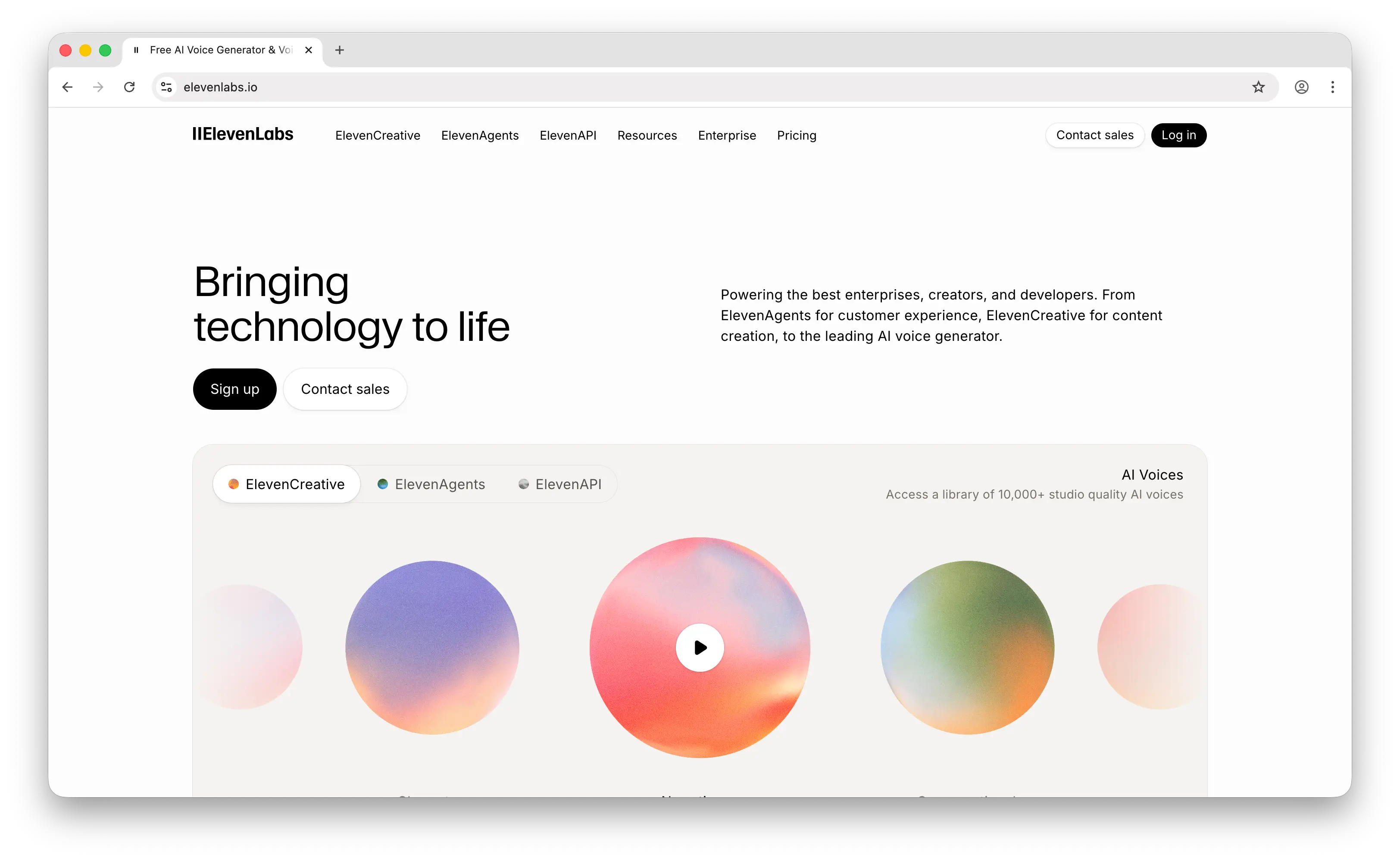
ElevenLabs is best known for its industry-leading text-to-speech, but its Scribe v2 speech-to-text model—launched March 11, 2026—has become a credible AssemblyAI alternative, particularly for teams that want a single platform covering both STT and TTS.
What Makes It Different
Scribe v2 is purpose-built around speaker labeling and multilingual coverage. ElevenLabs claims 98% speaker label accuracy and improved turn-level timestamps, which makes it strong on multi-speaker workloads like podcasts, interviews, and customer calls. It supports transcription in 99 languages and has a Live API expanded to 57 languages for real-time streaming, with Scribe v2 Realtime delivering ultra-low latency suited to conversational AI agents.
The pricing is aggressively competitive. Scribe v2 starts at around $0.28 per hour of audio—roughly 40% lower than v1, and competitive with AssemblyAI's Universal tier once you factor in that diarization is included in the base rate rather than charged separately. ElevenLabs also offers up to 30+ simultaneous streams for enterprise clients and supports WebSocket streaming for live transcription workflows.
The bigger strategic advantage is that ElevenLabs is a full audio platform, not just STT. You get industry-leading TTS (Multilingual v2, Flash), voice cloning, dubbing, sound effects, music generation, and a Conversational AI Agents platform on the same account. For teams building voice agents or audio products, having STT and TTS from the same vendor reduces latency and integration complexity.
Key Differences from AssemblyAI
ElevenLabs Scribe is newer to STT and its audio intelligence stack is thinner than AssemblyAI's. There's no LeMUR equivalent for LLM analysis on transcripts, sentiment and topic detection are less developed, and PII redaction tooling is less mature. The credit-based pricing model (shared across TTS, STT, dubbing, music) can also be harder to predict than AssemblyAI's straightforward per-minute billing, especially if your usage spans multiple ElevenLabs products. There's no Voice Agent API in the AssemblyAI sense—ElevenLabs has Conversational AI Agents, but it's a different product paradigm focused on full-stack voice agents rather than transcription analytics.
Comparison Table
| Feature | ElevenLabs | AssemblyAI |
|---|---|---|
| Pricing model | Subscription + pay-as-you-go (credit-based) | Pay-as-you-go (per minute) |
| Cost (STT) | ~$0.28/hr (Scribe v2) | $0.15/hr (Universal) – $0.27/hr (Slam-1) |
| Effective cost with features | ~$0.28/hr (diarization included) | ~$0.45/hr at parity |
| Free tier | 10,000 credits/month (recurring) | $50 one-time credit |
| Speaker diarization | 98% accuracy |
|
| Real-time streaming | (Scribe v2 Realtime, 57 languages) |
|
| Turn-level timestamps | |
|
| Sentiment / entity / topic detection | Limited | (rich) |
| PII redaction | Limited | |
| LLM-powered analysis | |
(LeMUR) |
| Text-to-speech | Industry-leading |
|
| Voice cloning | |
|
| Conversational AI agents | (full platform) |
(Voice Agent API) |
| Dubbing / localization | |
|
| Languages (STT) | 99 | 99 |
| Languages (Live API) | 57 | 99 |
| Unified STT + TTS platform | |
|
| Best for | Teams building voice agents or audio products needing both STT and TTS | Teams needing deep transcription analytics and LLM analysis |
Which Should You Choose?
Choose Puter.js if you're building a web app and want to add speech-to-text features without any backend or API costs. The user-pays model is ideal for frontend developers who don't want to worry about covering their users' transcription costs, and the multi-provider support (OpenAI Whisper, GPT-4o Transcribe, xAI Grok STT) gives you flexibility without vendor lock-in.
Choose OpenAI STT if you need straightforward per-minute pricing with no à la carte add-ons and want access to one of the most accurate transcription models available. It's the best option for teams already in the OpenAI ecosystem who want simple, affordable transcription—and the only option here where you can self-host the model (Whisper) on your own GPU.
Choose Deepgram if you're building real-time voice agents or high-concurrency streaming workloads. Its sub-300ms latency, per-second billing, 500 default concurrent streams, on-premises deployment option, and $200 in free credits make it the strongest choice for production voice infrastructure where speed and scale matter more than audio intelligence depth.
Choose Amazon Transcribe if you're already deep in AWS, processing millions of minutes per month, or need HIPAA-eligible medical transcription. Its 100+ language coverage, Transcribe Medical and Call Analytics variants, deep AWS integration, and aggressive volume discounts at scale make it the practical choice for enterprises with existing AWS infrastructure.
Choose ElevenLabs if you're building a voice product that needs both transcription and speech synthesis from the same platform. Scribe v2's strong speaker labeling, competitive pricing, and tight integration with ElevenLabs' industry-leading TTS and Conversational AI Agents make it the right pick when STT is one half of a full voice loop.
Stick with AssemblyAI if you need the deepest audio intelligence stack on the market—LeMUR for LLM-powered transcript analysis, mature sentiment and topic detection, strong PII redaction, and rich entity recognition all in one developer-friendly API. It remains the most comprehensive option for teams that need to extract structured insights from audio at scale.
Conclusion
The best AssemblyAI alternatives are Puter.js, OpenAI STT, Deepgram, Amazon Transcribe, and ElevenLabs. Each takes a different approach to speech-to-text—from Puter.js's zero-cost frontend integration to OpenAI's accuracy-per-dollar to Deepgram's real-time streaming to Amazon Transcribe's AWS-native scalability to ElevenLabs' unified STT+TTS platform. Whichever platform you choose, the best option is the one that fits your stack, your budget, and how your users will interact with voice in your app.
Related
- Getting Started with Puter.js
- Free, Unlimited Speech-to-Text API
- Free, Unlimited OpenAI API
- Free, Unlimited Grok API
- Free, Unlimited ElevenLabs API
- Free, Unlimited Voice Changer API
- Free, Unlimited Text-to-Speech API
- Free, Unlimited OpenAI Text to Speech API
- Best Text to Speech APIs in 2026
- Best Deepgram Alternatives (2026)
- Best ElevenLabs Alternatives (2026)
- Best AWS Bedrock Alternatives (2026)
- Top 5 Google AI Studio Alternatives (2026)
- Top 5 OpenRouter Alternatives (2026)
- Top 5 Replicate Alternatives (2026)
- Best Together AI Alternatives (2026)
- Best fal.ai Alternatives (2026)
Ship a Full-Stack App with One Prompt
Create a to-do list app using Puter.js
Coding manually? see the guide